Yesterday’s post was first handwritten on my Remarkable2, then auto-transcribed to text, emailed to myself, and pasted into WordPress.
It’s been at least six months since I tried Remarkable’s writing-to-text service, and the improvement is, well … remarkable!
It still doesn’t recognize bulleted or numbered lists well, or even simple paragraph breaks. But after I pasted the text, I made only one correction to one mistranscribed character in this entire post; it even recognized ‘Tetlockian‘! I took the slightest bit of additional care to write neatly, but not enough to slow me down or distract from writing. And I wrote in my normal ~80/20 mix of cursive and printing.
I wonder if the improvement was the integration of newer and more powerful models, tuning, or if I’m just imagining it?
Previously, the Remarkable service struggled to recognize my writing’s characters themselves and struggled to identify word breaks properly, meaning it never was quite good enough justify using it. I would have to spend more energy on writing extra neatly than was worth it to get the transcribed text. So I would use the Remarkable2 only for my own notes, never when I would need the text. This is supposed to be a huge value prop of the platform, so I’m glad it’s working so much better now. I think it will reinvigorate my usage of the product.
Years ago when I first started at Relativity, we had an amazing engineering leader named Security Bill.
Security Bill taught us a lot. For instance, he knew our most likely breach scenario was low-tech: someone tailgating into our office behind a polite door-holder, then sticking a USB into an unlocked machine. So Bill set out to create a new norm. Everyone would badge into every door, every time. If you were walking back from lunch with your best work friend, and the CEO happened to be walking behind you? All three must badge in, one at a time. If the CEO was distracted, late, in a rush, and forgot to swipe his badge, it was your duty to remind him he needed badge in. Even if you were just an intern. This would usually mean stopping right in the doorway and physically standing in his way. It was a hard norm to enact in a company of a few hundred people, but Security Bill was a patient and persuasive man. Leadership bought in first, and slowly the new norm stuck. Within a couple of months, the whole company was badging in, and holding each other accountable.
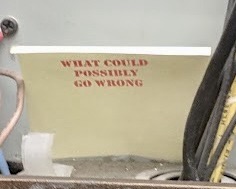
But the badge norm protected against only the first half of the threat, and still wasn’t foolproof. So Bill also had a custom stamp with a red ink pad. He carried the stamp and ink in a little case, along with a fresh set of yellow sticky notes. If you stood up for a drink or bathroom break and didn’t lock your computer, and Security Bill happened by, you’d return to find a sticky note on your monitor. On the yellow paper would a red stamp that read in block letters “WHAT’S COULD POSSIBLY GO WRONG?”
And Security Bill was always willing to describe for you what could possibly go wrong.
Security Bill taught us other things, beyond how to have a security mindset. I was once asked in a meeting to do something that was outside my skill set and comfort zone. I said something like, “I’m not very technical, I don’t think I can own this.” Bill encouraged me to try, and offered to help if I got stuck.
After the meeting, he pulled me aside and told me a story. “When I was young, my parents sent me to work on my uncle’s farm for a summer. For the first two weeks, every day I was asked to do something I had never done before. What would he have said to me if I’d told him, ‘I’m not very agricultural, I don’t think I can do this.’ Some things are hard. But we’re smart, and we figure them out.”
Security Bill created a permanent security mindset at Relativity. Throughout his career he also helped me and hundreds of others learn how to build a culture of excellence; how to fight an uphill battle and win; when to be a careful thinker, and when to jump in and figure it out.
At Steve Jobs’s funeral, Jony Ive told a story about Jobs’s bottomless perfectionism:
As I’m sure many of you know, Steve didn’t confine his sense of excellence to making products. When we traveled together, we would check in and I’d go up to my room. And I’d leave my bags very neatly by the door. And I wouldn’t unpack. And I would go and sit on the bed. I would go and sit on the bed next to the phone. And I would wait for the inevitable phone call: “Hey Jony, this hotel sucks. Let’s go.”
Luckily for us, Jobs channeled his personal unbalance into a company that tilted the world’s expectations of personal technology products. Jobs famously said that the world is a better place with Apple in it, which is true. But, as Ives noted later in his remarks, the effort took a toll on Jobs and those around him. It’s not always an easy way to live.
All of us would do better work if we were a little more naturally Jobsian. But most of us would also be less happy. One skill I’ve tried to cultivate at work is to constantly raise my own expectations, and to ask over and over again, “Why can’t this be better?”
Luckily for me, this takes effort, it doesn’t come naturally. I don’t have to live with a pathological design sensibility when I’m not at work, and neither do my friends and family. But there are other ways in which I’m unbalanced; over the years, I’ve tried to recognize them, and figure out how to use them to my advantage–instead of fighting it, to throw my weight against something in the world that needs to be shifted.
Living through the birth of both AI and true virtual reality, the US government acknowledging UFOsUAPs, a global pandemic and multiple history-shaking wars, all coinciding with economic prosperity for some, and famine and mass displacement for others. There’s a lot going on, and it can feel destabilizing.
And for me, that destabilizing feeling has lately manifested itself in a strange way. Sometimes I just can’t escape the feeling that I’m looking through my eyes at some kind of projection. My mind keeps wandering back to a few years ago when a lot of tech people talked about the likelihood that our world is a simulation being run by a more advanced one. The chances of being alive during such a strange and momentous time feel so remote, that maybe our probabilistic brains are attracted to the simulation idea, because somehow it feels a more plausible idea among all this rapid change. I don’t remember ever having this feeling before a year or two ago. Now I feel it pretty often.
I don’t think we’re actually living in a simulation. Which makes this feeling even weirder when it hits me. The world just seems stranger, and change just seems to accelerate. It’s interesting to observe my mind as it integrates all this change, and the weird side effects, like fleeting suspicions toward reality itself.
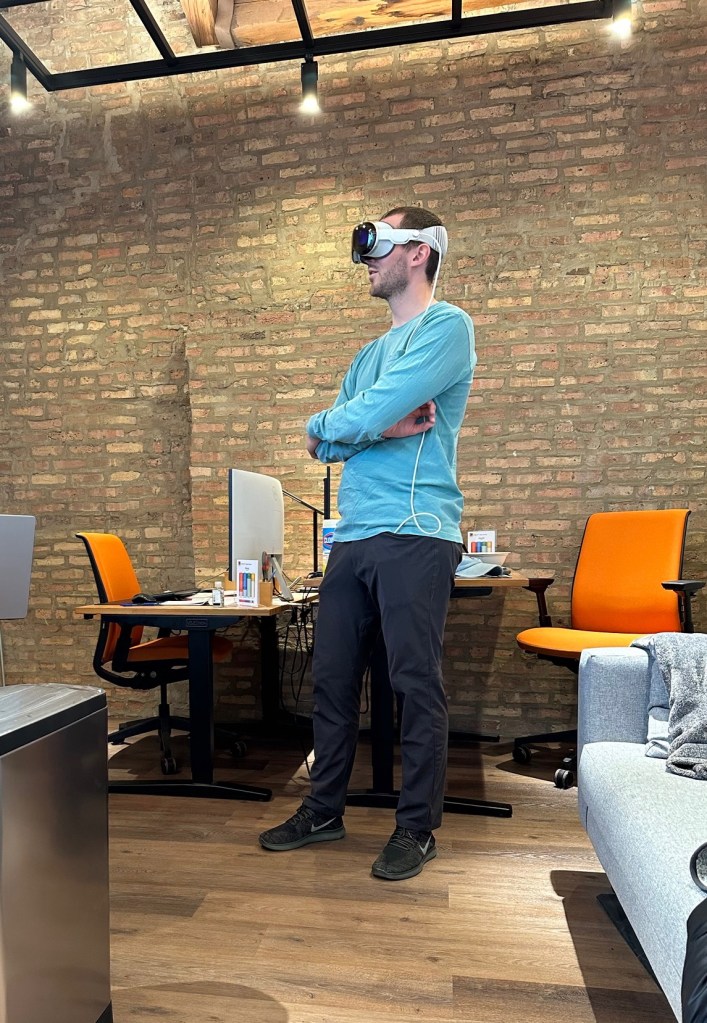
“Base reality blows.” … that is scratched into the bathroom mirror at one of my favorite coffee shops in Chicago. It’s also what I said after my very first test session on the Apple Vision Pro. A friend got one and was kind enough to let a few of us demo it yesterday. I was mostly joking, but my first experience on the thing was certainly enough to make me ponder that message on the bathroom mirror.
Here are the first impressions from my two friends and me:
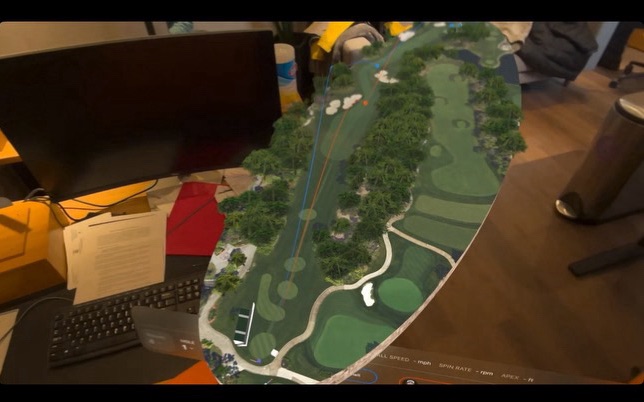
The Engineer: “My very first impression was that it feels like a proof of concept, not a “real” product yet. All the polish you’d expect from Apple hardware is there, that’s what makes Apple … Apple. Learning the eye-tracking and hand gestures was initially challenging and buggy. But that was before we realized how important it is to redo the Eye- and Hand-Detection set-up every time you switch users. After that, it’s much smoother. I can see why this will be really nice for programmers. It feels a clear step ahead of the Meta Quest. The most impressive experiences are the few pre-loaded demos from Apple and their launch partners: taking apart a life-sized F1 car; standing in Alicia Keys’s studio while records a song; standing on a slack line 2,000 feet above a mountain lake in New Zealand; practicing open heart surgery; looking down on a table-top PGA Tour golf-course while the leaders play around the course simultaneously. Right now, there’s not a ton to do with it, other than those demos and watching videos. But they are enough to make you a believer in what the future holds.”
The PGA tour app gives you a tabletop view of the course, from which you can jump into any hole and “walk the course.“
The Visionary: “There are little moments that are just mind-blowing, like when I realized I could physically walk over to a screen in the room and tap on it. Right now (in base reality) we’re in a small room, and virtual reality I have YouTube on one wall, iPhoto on the opposite wall, and Apple TV+ on a third wall. Looking around at my different screens is effortless and natural. The gestures and commands for interacting with them aren’t 100% nailed yet, but you get used to them in a couple of hours. There are almost no third-party apps, but it will be interesting to see what developers do with it eventually. It feels like there’s more opportunity for voice commands. The number of units sold is still so small (200K so far), but still it feels like there are a bunch of businesses you could build on this thing as more people buy it.”
The Optimist (Me): I had read and listened to a ton of reviews and discussion of the device, so I was probably as primed as anyone could be on what to expect–both the good and the bad. Still, the experience of using it exceeded my expectations. There’s not just one mind-blowing moment, but a quick succession of them as you get used to the different things you can do. The one letdown was viewing Spatial Video that I’d captured myself. We just happened to be on our honeymoon when the iOS update supporting Spatial Video dropped, so I started capturing some in the Torres del Paine National Park in Chile. The timing was lucky–if I’d gotten the update three days later, I would never have had such an epic laboratory to experiment in. Still, I had no idea when I’d get to use a Vision Pro, so it was awesome that I got to try one so soon. But I found the Spatial Video to be not necessarily better than any other iPhone video. And Pano photos were surprisingly as good, if not better.
Quibbles aside, my expectations were shattered. I am truly impressed. My biggest take away is that, if I had one of these, it would likely be enough to get me to switch from Windows back to Mac for my main PC. I left Mac after college, and never looked back. So this is a big change. The productivity potential, especially when traveling or working anywhere other than my main workspace, feels immense. But with a price tag around $4,000 with tax, I won’t be buying one any time soon.
So, while base reality is not yet obsolete, my prediction for how much time I’ll spend here just went down. And my understanding of it may change too. Driving home after playing with the Vision Pro for a few hours, the world looked somehow both more and less real.
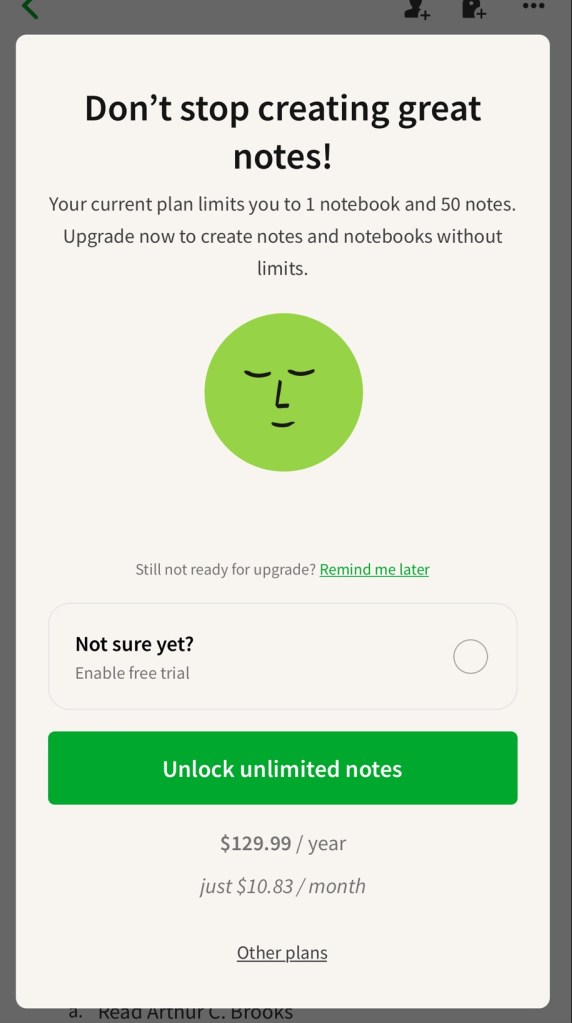
One of my favorite companies is trying to dump me, and I get it. I’ve been using Evernote for over 10 years, and suddenly they really, really want me to upgrade, or leave. Every time I open the app, I get a full-screen pop-up like this:
I have WAY more than one notebook and 50 notes.
Part of me does feel jilted … at ~20 years old, this company is one of the longest-running freemium consumer businesses on the internet. Now, the constant bombardment with upgrade pop-ups feels a bit like they’re punishing their free users for opting into that model.
But, I won’t listen to that part of me, because I understand what the company is dealing with. Evernote supports over 200 million users (!), with the vast majority on the free version. The company has weathered 2008, COVID, the latest tech bubble burst, and everything in between. Not to mention thousands of competitors with VC dollars to burn. In the meantime, the product has gotten better every single year, and I have consistently loved it.
Reading the announcement that preceded this upgrade campaign, I wasn’t surprised to learn that I use much more data and more functionality than the typical free user. This is why I’m part of the annoy-till-they-buy-or-quit cohort. And I have to give the Evernote team credit: six months into this, and it’s still just barely below the pain threshold that would have made me either upgrade or leave by now. They could have made it much less tolerable than a pop-up, or straight up forced me to upgrade or lose my data. Instead, I’ve been allowed to keep using the app, even though I’m way over the newly defined free tier. To their further credit, they understood they’d definitely lose some users doing this. They were honest about that in the blog, and they remain committed to users’ data ownership and data portability.
Like all software companies, Evernote is operating in a much tougher economic environment, and they could no longer support so many free users and so much free data. I’ve enjoyed almost 11 years of usage and improvements, at no cost. For all that time, Evernote worked hard to build the best app they could, and erred on the side of giving free users too much value, not too little. Now it’s time for me either to give back some of that value, or upgrade. I will probably upgrade … eventually.
LLMs are still moving fast. I’d seen some speculation that a plateau is approaching, but so far it has not arrived. I’ve been out of the loop less than three weeks, and while I was gone: Google’s Gemini had a PR disaster, Anthropic launched its Claude 3 model family, and Groq launched its public web app (not to be confused with Grok).
The Groq launch made enough waves that despite being unplugged, I heard about it during our honeymoon and tried it out. The speed is impressive. Using Groq was a good reminder that on any dimension, one product’s “good enough” can be another’s differentiator. Six months ago, a one-, five-, or even ten-second wait for an answer from ChatGPT was absolutely worth it. The technology was so new and the conversations so valuable that the wait was both understandable, and obviously worth it. If you’d told me then that some new model (or in this case, some new architecture+hardware) was faster, I would not have been so excited. What I still want most is the better (more intelligent) model, not the faster one. I would have said speed is nice, but it’s clearly a secondary concern. That’s still how I feel, but my experience with Groq has made this a much closer call than I would have expected or predicted.
Groq’s primary product appears to be the chip and the architecture, not the chatbot, so I don’t expect to see my usage migrate from ChatGPT to Groq. Maybe OpenAI will acquire them. But it did get me reflecting on what would get me to change products, or adopt additional products for specific tasks. Over the past few months, 95% of my LLM usage has been via ChatGPT. I will try a new product when it launches—I tried out Gemini Pro 1.5 for a few days before we left on our trip, before its issues surfaced. I will also try different products when I want different opinions—for a recent research project I was asking the same questions simultaneously to ChatGPT, Gemini, and Claude. But so far, nothing has come close to displacing ChatGPT as my go-to LLM. The first-mover advantage is real, and OpenAI’s pace of innovation has been fast enough to retain their early lead, at least for me. But Groq reminded me that the race is far from won.
Answering machines and obituaries are still funny. At least for now. I’ve been re-watching Curb Your Enthusiasm, Season 1, which originally aired in the year 2000. The episode premises are all about these things–answering machine messages; obituary typos in the physical newspaper; the cutoff time when calling someone’s home phone in the evening (and how it differs if they have kids?); which day of the week do you call to confirm Friday plans; hard-to-follow driving directions; etc.
More than half of Season 1 episodes seem to have at least one plot point hinging on home phones, “car phones,” answering machines, or pagers. The jokes still work for me, but I wonder if my kids will be able to relate to it at all. All the more reason to re-watch now!
I cannot wait until there are no more human drivers. This thought initially crossed my mind when I first drove a Tesla. Lately, I think about it nearly every day, whether I’m walking, biking, or driving. During just a two mile trip this morning, I saw two blown red lights; two people swerve over the center line while texting; and two attempts to pass on the right in a bike or parking lane. That is a serious safety incident every 1/3 mile! The better self-driving technology becomes, the less safe I feel sharing the road with people.
I remember learning to drive as a kid, seeing oncoming traffic in the other lane, and being amazed at the level of trust we all put in each other with these machines. And that was before the constant distraction of smartphones. The societal value of cars has always outweighed the costs, I think by far. But within a few years we will be able to remove the safety trade-off from the equation altogether. If we have the political will.
As technology improves, the safety disparity between human drivers and machine drivers will become so glaring, so overwhelming, that fully autonomous cars will be legalized everywhere. I’m confident in this prediction. To make human drivers on open roads illegal will be harder, but I think worth trying. Car and gun fatalities in the US both come in around 40,000 per year. But the vast majority of car fatalities are accidental, while the vast majority of gun fatalities are not. So car fatalities should be more preventable. And unlike gun ownership, there is no explicit constitutional right to driving. So driving prohibition should be less legally controversial.
If it happens at all, the banning of human drivers in the US will proceed state-by-state, and may break along political lines. If it happens, the effort will likely be led by grassroots advocates, mostly families of victims–something like MADD on steroids. Car nuts can migrate to closed recreational courses, and the rest of us can text and ride, guilt free. I hope it does happen. I hope our societal attachment to the open road is less dear than our attachment to gun ownership.
I hope one day we all feel truly safe on the road, which to me would mean living in a time and place where humans aren’t allowed to drive. Until then, I’ll be cheering on Tesla and their competition as they race toward full autonomy.
I’m blogging from my phone today, over coffee at Ground Central in Hell’s Kitchen. I’m at a conference I’ve been coming to for 10+ years, and for most of those, this shop has been my respite whenever I have 20 minutes to sneak away from meetings.
Sitting here now—as I’m writing on a giant iPhone 15, using the Jetpack app for WordPress—I’m thinking about how long technologies take to mature. When I started coming here, mobile and cloud were both still new-ish, especially in the legal market, where I work. I remember mobile data challenges being a big problem in legal tech. Companies dealing with mobile data were the hot startups for a few years here. Similar story for cloud, the legal market was the last to arrive.
When I left my job a few months ago, I turned in my work laptop. I bought a Chromebook and it’s my only laptop right now. 10 years ago, this would have would have been unthinkable. I still use Microsoft Office products daily. But the web and iOS apps for Office work great now, and it’s all tied together by OneDrive. I can get by with a Chromebook until I’m full time again, no problem.
By the way, if you’re around Times Square check out Ground ace the coffee is good, as are the music and sound system. Today they’re playing Regina Spektor, Yeah Yeah Yeahs, and White Stripes.

 sabbatiblog