“You cannot become happy. You can only be happy, in this moment, right now.”

As I exit my sabbatical, I’ve spent more time thinking about what’s next. These thoughts tend to with come hopes, desires, and worries. But they don’t have to.

This year has been the first time in my life I haven’t had a plan or timeline for my next phase. That openness has helped me appreciate the present, and be wary of the future. I’ve learned to notice when I’m ruminating on the future (rather than taking practical steps along my desired path). It gives me an uncomfortable feeling, like leaning too far over high ledge.

In my meditation app recently, I heard this advice:

“You cannot become happy. You can only be happy, in this moment, right now.”

We should still make plans and follow through with them. But we shouldn’t confuse those plans for living a good life.

Every moment an eternity.

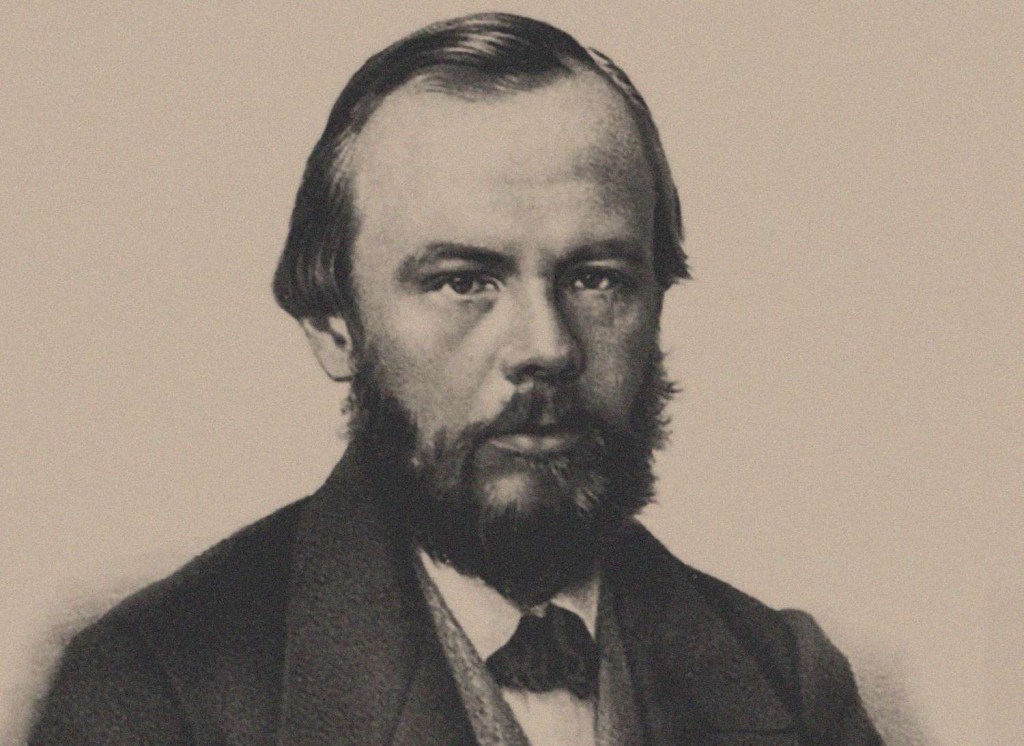
Hours after he stood in front of a real firing squad in what turned out to be a mock execution, Fyodor Dostoyevsky, wrote to his brother Mikhail:

When I look back at the past and think of all the time I squandered in error and idleness, lacking the knowledge I needed to live; when I think of how I sinned against my heart and my soul, then my heart bleeds. Life is a gift, life is happiness … Every moment could have been an eternity of happiness! If youth only knew. Now my life will change, now I will be reborn.

The execution was staged to make Tsar Nicholas look merciful when the actual sentence was handed down for Dostoyevsky’s political subversion: four years of hard labor in a Siberian prison camp. In the letter, he is describing the feeling that grabbed him in what he genuinely believed were his last moments on earth. As he saw the sunlight glinting off of a church steeple, the people moving through the square, and other everyday sights, he tried to fully experience each moment, stretching each into a brief infinity.

I’d heard the story of the mock execution, but only learned about the letter a few weeks ago, and the novelist’s turn of phrase has been rattling in my head ever since. It has become an effective mindfulness device. “Every moment an eternity,” I think to myself lately, any time I manage to catch a moment of mindfulness amidst the normal rush of daily life.

Meditation trains our minds to be present, not just in the few minutes of actual practice each morning, but throughout the rest day. Breaking the spell of distraction, over and over again, is the only goal. And this thought has helped me succeed at that goal more often over the past few weeks.

Trains of thought.

As a kid, I used to lie in bed at night, thinking. I’d imagine things, tell myself stories, or replay the day’s events. Eventually it would be late enough that even my kid brain worried I’d be tired the next day, and I would tell myself to stop thinking and try to sleep.

The thing that usually tipped me off that I’d been “daydreaming” too late into the night was suddenly becoming aware of my current thought, and realizing I had no idea how I’d gotten there. When this happened, I’d play a game of retracing my mental steps before falling asleep. It would go like this:

“… velociraptor, that is definitely the best dinosaur. Wait why am I thinking of dinosaurs? I was thinking of basketball practice tomorrow.”

“… dinosaurs, which came from velociraptor, which came from Toronto Raptors … Vince Carter … I wish I could dunk … basketball practice tomorrow.”

Today I was reminded of how I used to play this mental retrace game. I was listening to my meditation app, and the guest teacher Joseph Goldstein retold a Buddhist proverb that compares the untrained mind to a waterfall, always tumbling down. The metaphor that’s more common in Western speech, he continued, is the train. We lose our ‘train of thought’ all the time, which can happen only when we’re identified with (lost in) thought, rather than observing thought. When our minds wander, Goldstein says, it’s like “hopping on a train, and never knowing the next stop,” or even like “falling asleep on a train and then awakening, not knowing where you are or how you got there.”

Awakening is the practice of breaking the spell, realizing you were lost in thought, and no longer being identified with thought. It was fun to remember back to being a kid, and realize that many nights lying alone, I’d been doing something like meditation practice, without knowing it.

Wisdom gets truer the more you believe in it.

You should sit in meditation for twenty minutes every day—unless you’re too busy; then you should sit for an hour.

Dr. Sukhraj Dhillon

I saw the above quote in a book years ago. At the time, my interest in meditation had begun, but I had not practiced very much or very consistently. The advice sounded nice, but I couldn’t imagine believing it myself, let alone following it. I was just too busy, and the things I was busy with just too important.

Years later, this advice still sounds difficult to follow. But it also feels (to me) more achievable, and much truer. Its meaning has deepened for me as well, such that I can now read this quote in several ways, all of them seeming true.

I think this is a good definition of wisdom in general. Wisdom is a type of knowledge that gets truer the more experience you have with it, the more you believe in it, the more you adhere to it.

ChatGPT is a university in your pocket.

ChatGPT is a university in your pocket. One new way use I’ve found for ChatGPT is to “go back to school.” I can design and take a course on-demand, but unlike a MOOC, I can also fully customize it. In pursuing my vision for this sabbatical, one of my ideas was to revisit some things I learned about way back, in some 100- or 200-level philosophy course: the aesthetic concepts of Awe and The Sublime.

Before getting into the details, how does this relate to my vision? Religion never resonated for me, but as I’ve gotten older, I’ve felt a pull to discover and develop the spiritual dimension in my life, in my own way. I’ve been meditating pretty consistently for several years, but during this time away from work I wanted to focus even more on the spiritual dimension of my life. Like all my interests, eventually I asked ChatGPT about it. This started as a conversation, and later I had the idea to ask ChatGPT to design an actual syllabus, for an imaginary course I wish I’d taken back in college.

Before ChatGPT, I would have done one of two things. Either I’d have ordered several books on my topic of interest, and probably not have read them; or I’d have done some haphazard Wikipedia and YouTube deep dives. The former is almost worthless. The latter is not much better—I would learn some surface-level stuff, but would be unlikely to engage with the material in an organized way. So I wouldn’t gain deep and lasting knowledge.

But ChatGPT has lowered the bar for engaging with complicated ideas. If you like the idea of taking a course, it can literally design the syllabus, organize the readings, generate lectures, and act as both a professor and TA. Most important for me, it makes me more likely to actually do the readings, because I can see where I am in the course and have a sense of progress; and because for any part that’s not interesting, I can just ask for a summary and skip it. At the margin, I’m much more likely to really learn something. If a full class isn’t interesting to you, you can structure your own learning however you want.

So before our honeymoon, I downloaded the first two readings from the syllabus to my Remarkable 2. Both are in the public domain, so I could easily find PDFs. I have been working through them at my own pace, and using ChatGPT for questions and context,

It’s obvious this technology will have an impact on Higher Education, or in my case, continuing education. But this is one way that it could be an opportunity for Higher Ed, rather than just a threat: let students design their more of their own courses, have professors review the syllabi and approve that they are “course credit worthy.” Assign TAs to give weekly oral quizzes, and then the professors design and administer oral mid-terms and finals. Maybe this can be done in cohorts, organized by year and major/elective area. I could see professors having fun with it too, adding personal favorites to the reading list, making it more esoteric but also ensuring it’s aligned enough with their knowledge base that they can easily administer the exams. We’ll see if universities embrace these types of experiments. I hope they do.
Honeymoon Day 7: Trekking in Baraloche

Me on hiking: “I get it now.” (It only took a trip to Patagonia.) View of our hotel and the lake.
Me on Mamba and Kelly on Barack. (Born November 4, 2008.)
Beet bun, lentil burger. I said vegan and gluten free, I wasn’t kidding.

Today I learned I do enjoy hiking after all. We took a steep and winding trail to a waterfall, and then further up to a vista overlooking the whole lake. It was only a couple of hours, but the payoff felt amazing. After lunch we went horseback riding around the property; our guide explained he’d left farming to come work here where the horses have easier, happier lives. Kelly’s horse, Barack, never fell more than a few paces behind our guide and the lead horse, Tupac. My horse, Mamba, had an attitude and was a bit lazy, lagging behind and stopping whenever she felt like it, but breaking into a trot as soon as the stable was in sight. But we developed an understanding and decided to show off our trotting for Kelly; we got along fine.

Finally we had a glass of Torrontés on the lawn before dinner. We learned this hotel and ranch has 500 acres, but a capacity of only 28 guests. No wonder it feels so private and calm.

It was a peaceful day. We’re super excited for a full-day fly fishing excursion tomorrow!

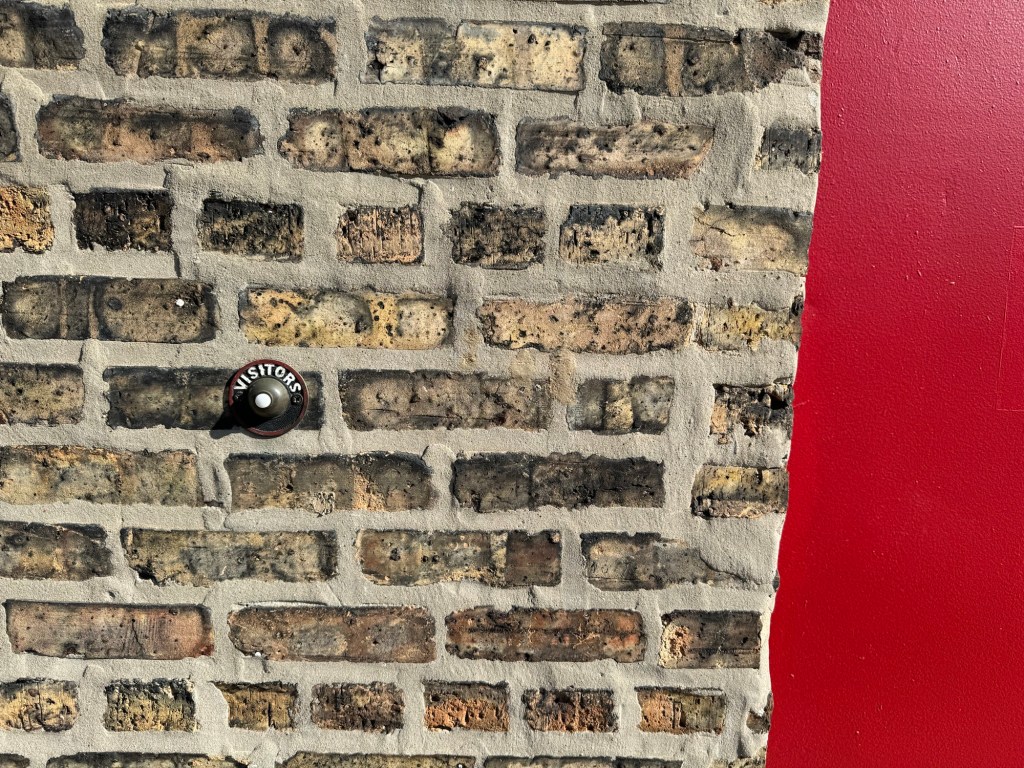
Has that doorbell always been there?

Has that doorbell always been there? Today I was walking from work to the coffee shop, a two-block stretch I’ve walked many times. But somehow I had never noticed this funny antique doorbell, though it’s at eye level and there’s not much else to notice on this block.

This little surprise got me looking around and noticing a bunch of other things in more detail. Big weird drainage pipes coming out of one building; attractive masonry arches on another; lots block glass windows. Purposefully noticing your surroundings can be like a walking meditation.

If you find yourself on auto-pilot while walking in your neighborhood, or even in your home or office, here a few things you can do to see your surroundings as new again:

  • Pick a color, and notice everything of that color. Choose red today, green tomorrow, blue the next day, etc.
  • Pick an object in your visual field, and try to focus not on the object itself, but on the space between you and it, almost as if you can see the air.
  • Pick a point in the distance. As you walk toward it, try and alternate between two perspectives: you moving toward the stationary point, vs. the point moving toward you. Does it work? Or is changing perspective in this way not possible?
  • Look for the thresholds and the seams … where a wall meets the ground, where a roof meets the sky, where the curb meets the street.

If you practice seeing something common with fresh eyes, that skill can bleed into other parts of your life in useful ways.

“This moment is all you have.”

“This moment is all you have.” That’s an invocation often echoed during guided sessions on Sam Harris’s Waking Up app. It reminds meditators that the current moment—what you’re actually experiencing right now—is the only part of your life that stands a chance of being “real.” All else is either a memory of the past or a hope for the future, and is in your imagination. Most experiences pass, only partially noticed, as you become self-identified with the next thought, and the next.

Observing your own consciousness in the present instant is like “waking from a dream.” Every moment not spent in mindfulness (the vast majority of our lives) is like dreaming, or as he sometimes puts it: “most of your life is spent talking to yourself, about yourself.”