“In all interactions, be either a teacher or a student.”

“In all interactions, be either a teacher or a student.” During my improv class last night, I was reminded of this mantra, which I adopted years ago during a period at work when I was really bored. Last night I was sitting there, a student, brand new, and still terrible at the thing we were practicing. It was uncomfortable, but not unpleasant. I was in the beginner’s mind. It was anything but boring.

Reflecting on that bad time at work, I remember endless meetings and busy work—nothing truly challenging, just overwhelming volume. Usually the answer to this type of challenge would be to prioritize what’s most important and ignore the rest. But I was also stuck in a rut, working on nothing very important. I didn’t want to leave, so needed to find something new to focus on. That search could fill only a small part of my day, so the rest was filled with picking up work no one else wanted to own.

So I was bored. Luckily, around that time a new leader joined us, who had an overt leadership style. He would spend as much time teaching others how to operate, think, decide, coach, as he would doing those things himself. He was always teaching.

And there I saw the answer to my boredom: like so many other problems, the best advice is the advice your grandma or grandpa may have given:

I fully endorse at least half of this sentiment.

Or to put it more encouragingly: Bored? Get curious.

If you feel like you’re on autopilot, ask how you could teach those around you to accomplish these things with as much mindless ease. If you feel others are wasting your time, find out why. Maybe they bored too, but no one has thought about whether this stuff is important.

Interestingly, practicing this mindset also helps you notice more viscerally when you’re the new, struggling, or confused person in the room. It makes you a better, more willing student. If every interaction is a teaching or learning moment, you can never be bored.
ChatGPT is a university in your pocket.

ChatGPT is a university in your pocket. One new way use I’ve found for ChatGPT is to “go back to school.” I can design and take a course on-demand, but unlike a MOOC, I can also fully customize it. In pursuing my vision for this sabbatical, one of my ideas was to revisit some things I learned about way back, in some 100- or 200-level philosophy course: the aesthetic concepts of Awe and The Sublime.

Before getting into the details, how does this relate to my vision? Religion never resonated for me, but as I’ve gotten older, I’ve felt a pull to discover and develop the spiritual dimension in my life, in my own way. I’ve been meditating pretty consistently for several years, but during this time away from work I wanted to focus even more on the spiritual dimension of my life. Like all my interests, eventually I asked ChatGPT about it. This started as a conversation, and later I had the idea to ask ChatGPT to design an actual syllabus, for an imaginary course I wish I’d taken back in college.

Before ChatGPT, I would have done one of two things. Either I’d have ordered several books on my topic of interest, and probably not have read them; or I’d have done some haphazard Wikipedia and YouTube deep dives. The former is almost worthless. The latter is not much better—I would learn some surface-level stuff, but would be unlikely to engage with the material in an organized way. So I wouldn’t gain deep and lasting knowledge.

But ChatGPT has lowered the bar for engaging with complicated ideas. If you like the idea of taking a course, it can literally design the syllabus, organize the readings, generate lectures, and act as both a professor and TA. Most important for me, it makes me more likely to actually do the readings, because I can see where I am in the course and have a sense of progress; and because for any part that’s not interesting, I can just ask for a summary and skip it. At the margin, I’m much more likely to really learn something. If a full class isn’t interesting to you, you can structure your own learning however you want.

So before our honeymoon, I downloaded the first two readings from the syllabus to my Remarkable 2. Both are in the public domain, so I could easily find PDFs. I have been working through them at my own pace, and using ChatGPT for questions and context,

It’s obvious this technology will have an impact on Higher Education, or in my case, continuing education. But this is one way that it could be an opportunity for Higher Ed, rather than just a threat: let students design their more of their own courses, have professors review the syllabi and approve that they are “course credit worthy.” Assign TAs to give weekly oral quizzes, and then the professors design and administer oral mid-terms and finals. Maybe this can be done in cohorts, organized by year and major/elective area. I could see professors having fun with it too, adding personal favorites to the reading list, making it more esoteric but also ensuring it’s aligned enough with their knowledge base that they can easily administer the exams. We’ll see if universities embrace these types of experiments. I hope they do.

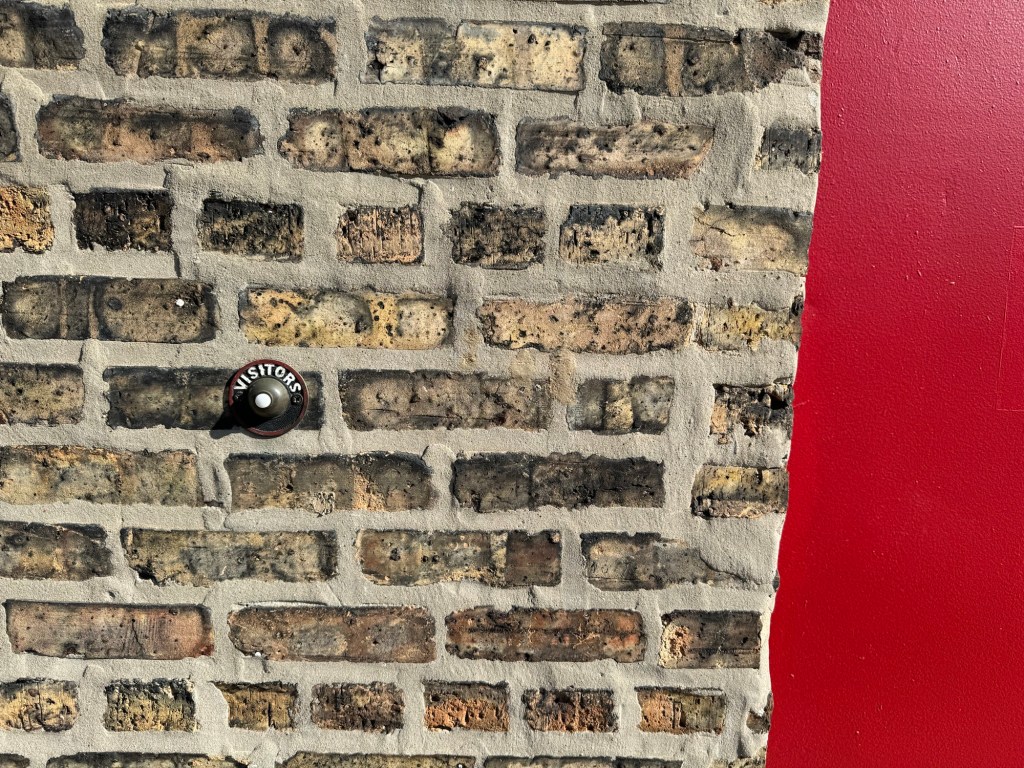
Has that doorbell always been there?

Has that doorbell always been there? Today I was walking from work to the coffee shop, a two-block stretch I’ve walked many times. But somehow I had never noticed this funny antique doorbell, though it’s at eye level and there’s not much else to notice on this block.

This little surprise got me looking around and noticing a bunch of other things in more detail. Big weird drainage pipes coming out of one building; attractive masonry arches on another; lots block glass windows. Purposefully noticing your surroundings can be like a walking meditation.

If you find yourself on auto-pilot while walking in your neighborhood, or even in your home or office, here a few things you can do to see your surroundings as new again:

  • Pick a color, and notice everything of that color. Choose red today, green tomorrow, blue the next day, etc.
  • Pick an object in your visual field, and try to focus not on the object itself, but on the space between you and it, almost as if you can see the air.
  • Pick a point in the distance. As you walk toward it, try and alternate between two perspectives: you moving toward the stationary point, vs. the point moving toward you. Does it work? Or is changing perspective in this way not possible?
  • Look for the thresholds and the seams … where a wall meets the ground, where a roof meets the sky, where the curb meets the street.

If you practice seeing something common with fresh eyes, that skill can bleed into other parts of your life in useful ways.

When was your last Aha! moment?

When was your last Aha! moment? The other day I referred to an “Aha! moment,” which depending on the context can also be called a Eureka Moment, a flash of insight, or even a brainstorm. Writing about it reminded me of a class I took in college called Insight in the Brain, where we studied the psychology of Aha/Eureka Moments, and the contrasts between “incremental” and “intuitive” problem solving.

Incremental problem-solving is long division, or checking every drawer until you find that sock. Insight problems are different. They usually can’t be solved little by little, by process of elimination, or with brute force. With insight problems, you’re sitting there with no answer and no progress, and then a solution comes to you, all at once, as if out of thin air. This can happen with hard problems that you’ve looked at from every angle but haven’t figured out; or with easy problems that require little effort. Either way, the answer comes suddenly, in a flash. If you know the problem space well, you may have an intuitive sense that there is a solution before you solve it; you just don’t see it yet.

In that class we learned the characteristics of insight problems, and the conditions under which insights usually occur. We also learned a clever way of studying them, a type of puzzled called a compound-remote-associates problem, where a subject is presented with three “problem words” and asked to find one “solution word.” For example, a problem triad could be crab / pine / sauce, and the solution could be apple (“crab apple,” “pineapple,” “applesauce”). Solutions to these problems tend to come all at once rather than incrementally or through trial and error, so they are good proxies for insight problems. And because they are easy to write and quick to solve, compound-remote-associates are convenient for testing various conditions under which insight can be boosted or blocked.

So how can we promote insight? First, do all the things you’d expect: get good sleep, hydrate, eat healthy foods, reduce stress, be in a good mood, etc. But for me the most important lesson from this class was simply to embrace subconscious processing. Give your subconscious some time and space to work.

Next time you have some problem you can’t quite crack, step away and think about something else. Or sleep on it for one or more nights. It really does work. Revisit the problem when and how you feel like it. Otherwise, relax and occupy yourself with other things. Eventually, the answer will hit you like a jolt from nowhere. It may happen on a walk, in a dream, or in the shower. Or even more poetically, in the bath, like the canonical (and still most famous) Eureka moment.

Ever since taking this class, I’ve been a huge proponent of allowing the subconscious to do its thing. Whatever the question, I am always encouraging people to “sleep on it.” And I mean literally. I sleep on things all the time. Most of the time I wake up with an answer. Even better, it feels like the solution has come “for free,” with none of the mental effort that would come with consciously working to an answer. There is no strain, it’s just there.

Try it out. Maybe you’ll engineer your own Aha! moment.

My vision for this sabbatical.

My vision for this sabbatical is To Pursue Spiritual and Intellectual Clarity. I wrote yesterday about my love for vision statements, so I want to share how I thought about this one. The spiritual and the intellectual are two dimensions in which I’ve long wanted to invest more time.

I felt pulled toward the idea of pursuit, because of course I don’t expect to achieve clarity during this short sojourn (or ever). But also because while plotting my adventure, I felt a desire to seek rather than to find. I’ve had this feeling on and off, maybe always, but I’ve never concentrated on it. The Seeker in me is the layer to be unearthed, the itch to be scratched.

As for how these two central pursuits will take shape and what they will truly entail, I have only vague notions. I will share my experience here, as best I can. I believe daily writing will be a clarifying ritual for me.