Honeymoon Day 3: Mendoza … Zonda and Entre Cielos

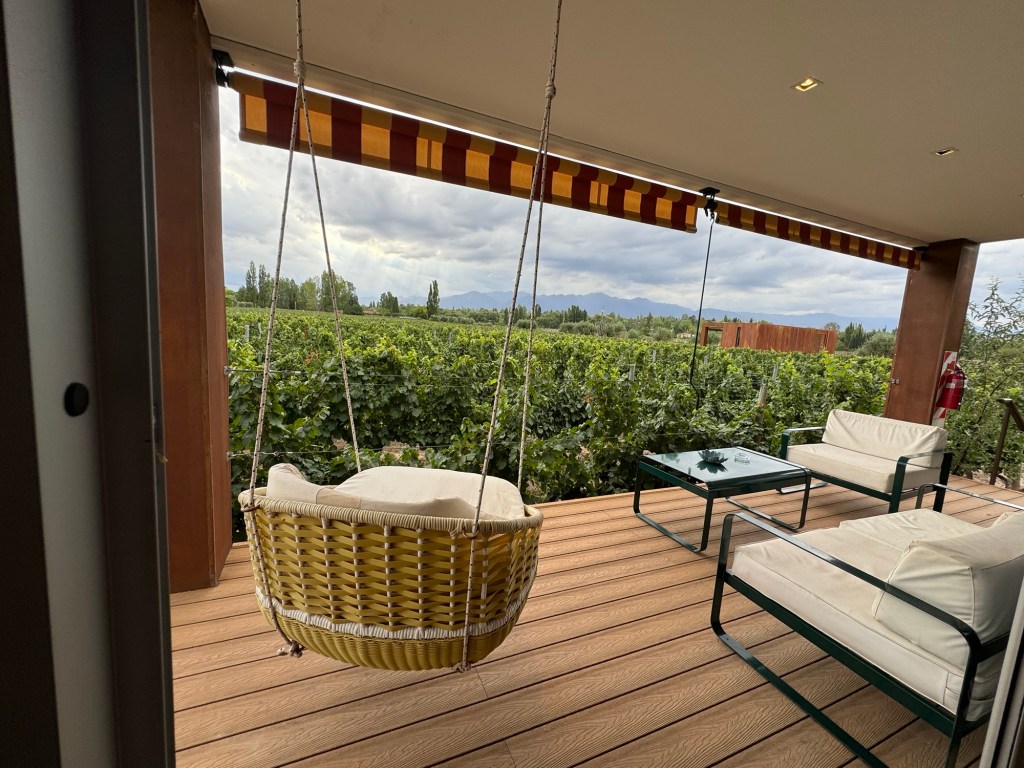
The view from our room at Entre Cielos in Mendoza. The hotel encourages you to reach down and sample the grapes.
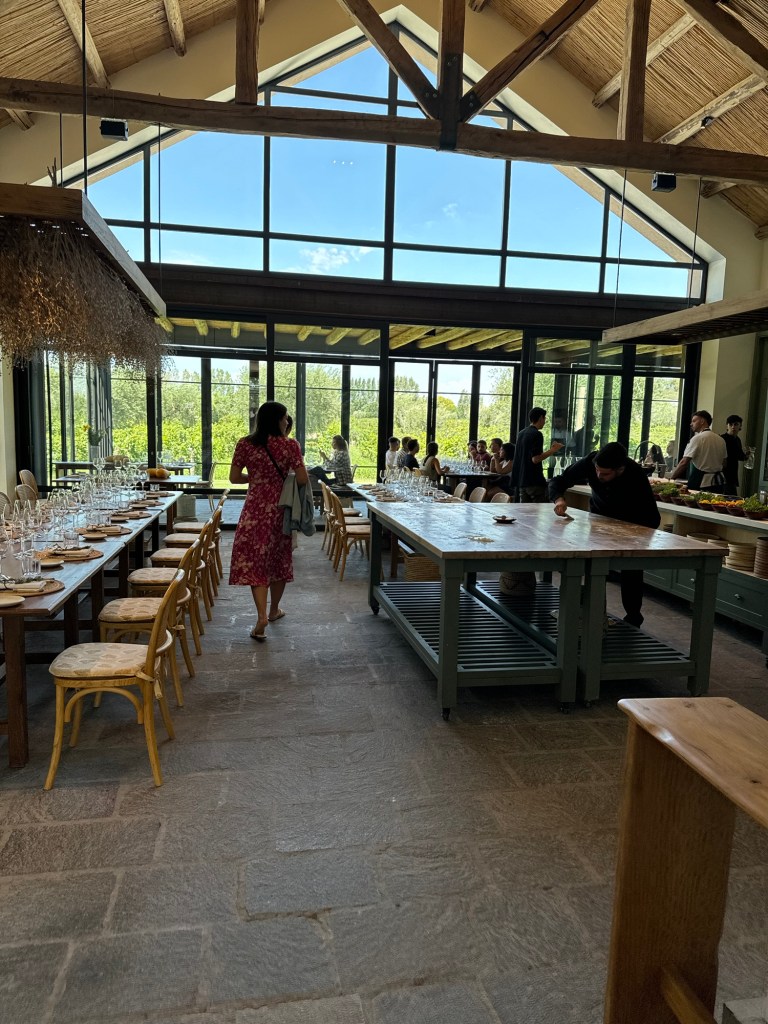
Two photos of Zonda Cocina de Paisaje, this may have been the best meal of our lives.
Hard to choose one dish, but the simple empanada may have been the best bite from many courses. Even better, they made Kelly a GF one. Our server: “We hate making this gluten free dough, it is so difficult. But it’s worth it so you can enjoy one.”

We made it to Mendoza and went straight to lunch, then to the hotel for a late afternoon spa session. We are super relaxed after two long days of travel and a busy day in BA.

Tomorrow we are looking forward to waking up on the vineyard, and then touring around to others for wine tasting.

Honeymoon Day 2: Buenos Aires

Giant oak door at our hotel, Mio Buenos Aires.
View into a mausoleum, Cementerio de la Recoleta.
Steaks at Don Julio. A must-visit.

Our first impression of BA is of vibrant energy. The people are friendly and open; the food and nightlife are exciting and you can see tango dancers in the streets. People LOVE Messi and Evita. We had amazing coffee at Tónico Cafe and walked around the central business / tourism district.

But, politics and the economy are top of mind for everyone, with inflation still very high (20% per month). US dollars are in demand, and tipping with US bills is appreciated everywhere. Memories of the Junta’s political violence are still fresh, just a generation ago. Protests against the current government are not going on now, but will return once summer ends. Still, overall the city is lively and the mood is positive.

Tomorrow we fly to Mendoza, and we’re both super excited for lunch at Zonda Cocina de Paisaje, which some friends recently visited and recommended very highly.

Honeymoon Day 1: Chicago to Houston to Buenos Aires

We leave today! I’m going to try something a bit more structured for posts during our honeymoon. Each day, I’ll post three pictures:

  • A picture of/from our hotel
  • A picture of something we did
  • A picture of something we ate or drank

Then I’ll write about one thing we want to remember from the prior day, and one thing we are looking forward to for the coming day.

So, here we go.

Nervously waiting out a delay in Houston. Luckily we took off.
The meal and accommodations for this evening.
BA is in the verdant Pampas region; it’s so green for a big city.

The flights were long but comfortable, I used every United mile and every Amex point I’ve earned since 2011 for upgraded tickets, so the flights were free.

For tomorrow, Kelly is excited to soak in the sights, sounds, and steaks of Buenos Aires. And I’m excited to find a cool coffee shop walking distance from our hotel (shocker, I know).

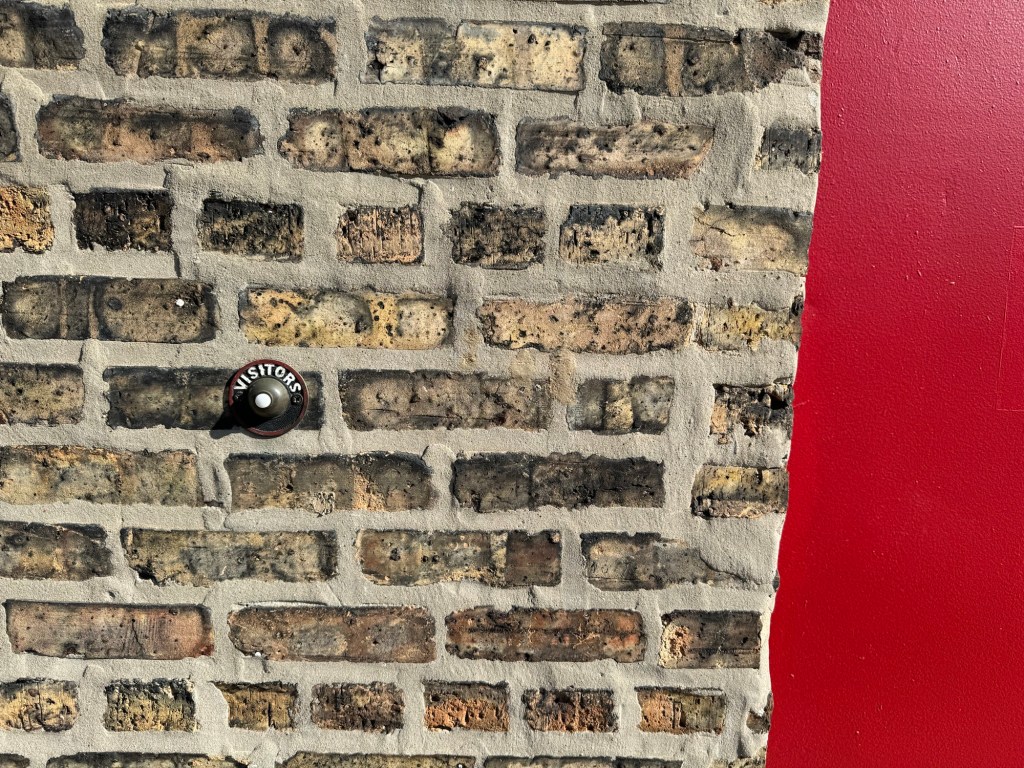
Has that doorbell always been there?

Has that doorbell always been there? Today I was walking from work to the coffee shop, a two-block stretch I’ve walked many times. But somehow I had never noticed this funny antique doorbell, though it’s at eye level and there’s not much else to notice on this block.

This little surprise got me looking around and noticing a bunch of other things in more detail. Big weird drainage pipes coming out of one building; attractive masonry arches on another; lots block glass windows. Purposefully noticing your surroundings can be like a walking meditation.

If you find yourself on auto-pilot while walking in your neighborhood, or even in your home or office, here a few things you can do to see your surroundings as new again:

  • Pick a color, and notice everything of that color. Choose red today, green tomorrow, blue the next day, etc.
  • Pick an object in your visual field, and try to focus not on the object itself, but on the space between you and it, almost as if you can see the air.
  • Pick a point in the distance. As you walk toward it, try and alternate between two perspectives: you moving toward the stationary point, vs. the point moving toward you. Does it work? Or is changing perspective in this way not possible?
  • Look for the thresholds and the seams … where a wall meets the ground, where a roof meets the sky, where the curb meets the street.

If you practice seeing something common with fresh eyes, that skill can bleed into other parts of your life in useful ways.

When was your last Aha! moment?

When was your last Aha! moment? The other day I referred to an “Aha! moment,” which depending on the context can also be called a Eureka Moment, a flash of insight, or even a brainstorm. Writing about it reminded me of a class I took in college called Insight in the Brain, where we studied the psychology of Aha/Eureka Moments, and the contrasts between “incremental” and “intuitive” problem solving.

Incremental problem-solving is long division, or checking every drawer until you find that sock. Insight problems are different. They usually can’t be solved little by little, by process of elimination, or with brute force. With insight problems, you’re sitting there with no answer and no progress, and then a solution comes to you, all at once, as if out of thin air. This can happen with hard problems that you’ve looked at from every angle but haven’t figured out; or with easy problems that require little effort. Either way, the answer comes suddenly, in a flash. If you know the problem space well, you may have an intuitive sense that there is a solution before you solve it; you just don’t see it yet.

In that class we learned the characteristics of insight problems, and the conditions under which insights usually occur. We also learned a clever way of studying them, a type of puzzled called a compound-remote-associates problem, where a subject is presented with three “problem words” and asked to find one “solution word.” For example, a problem triad could be crab / pine / sauce, and the solution could be apple (“crab apple,” “pineapple,” “applesauce”). Solutions to these problems tend to come all at once rather than incrementally or through trial and error, so they are good proxies for insight problems. And because they are easy to write and quick to solve, compound-remote-associates are convenient for testing various conditions under which insight can be boosted or blocked.

So how can we promote insight? First, do all the things you’d expect: get good sleep, hydrate, eat healthy foods, reduce stress, be in a good mood, etc. But for me the most important lesson from this class was simply to embrace subconscious processing. Give your subconscious some time and space to work.

Next time you have some problem you can’t quite crack, step away and think about something else. Or sleep on it for one or more nights. It really does work. Revisit the problem when and how you feel like it. Otherwise, relax and occupy yourself with other things. Eventually, the answer will hit you like a jolt from nowhere. It may happen on a walk, in a dream, or in the shower. Or even more poetically, in the bath, like the canonical (and still most famous) Eureka moment.

Ever since taking this class, I’ve been a huge proponent of allowing the subconscious to do its thing. Whatever the question, I am always encouraging people to “sleep on it.” And I mean literally. I sleep on things all the time. Most of the time I wake up with an answer. Even better, it feels like the solution has come “for free,” with none of the mental effort that would come with consciously working to an answer. There is no strain, it’s just there.

Try it out. Maybe you’ll engineer your own Aha! moment.
Our honeymoon will not be shot on iPhone.

Our honeymoon will not be shot on iPhone. At least not exclusively. My sister-in-law lent us her camera! She’s a photographer and is letting us use one of her old cameras on our trip. I say “old,” but it’s a professional-grade camera in great shape. We’re super grateful for her generosity, and excited to be amateur photographers during our travels.

She also gave us a brand new strap and a fresh SD card. We’ll pick up another SD card, so we’ll have 256 GB to fill, and I’ll be posting photos here during and after our trip.

We asked what we owed her for everything, and she laughed and said, “You owe me one camera, one strap, and one SD card. Just take care of everything and have fun.” We will.

We leave in two days. Thanks again Kerri!

“This moment is all you have.”

“This moment is all you have.” That’s an invocation often echoed during guided sessions on Sam Harris’s Waking Up app. It reminds meditators that the current moment—what you’re actually experiencing right now—is the only part of your life that stands a chance of being “real.” All else is either a memory of the past or a hope for the future, and is in your imagination. Most experiences pass, only partially noticed, as you become self-identified with the next thought, and the next.

Observing your own consciousness in the present instant is like “waking from a dream.” Every moment not spent in mindfulness (the vast majority of our lives) is like dreaming, or as he sometimes puts it: “most of your life is spent talking to yourself, about yourself.”

Some friends asked me to officiate their wedding.

Some friends asked me to officiate their wedding. I’m so honored! As most readers here will know, I love public speaking and one of my sabbatical goals is to practice as much as possible this year.

This wedding will be an opportunity to practice both writing and speaking, and in both efforts to summon as much heart and what little wisdom I can. I hope to be worthy of the occasion and to honor my friends.

Answering machines and obituaries are still funny.

Answering machines and obituaries are still funny. At least for now. I’ve been re-watching Curb Your Enthusiasm, Season 1, which originally aired in the year 2000. The episode premises are all about these things–answering machine messages; obituary typos in the physical newspaper; the cutoff time when calling someone’s home phone in the evening (and how it differs if they have kids?); which day of the week do you call to confirm Friday plans; hard-to-follow driving directions; etc.

More than half of Season 1 episodes seem to have at least one plot point hinging on home phones, “car phones,” answering machines, or pagers. The jokes still work for me, but I wonder if my kids will be able to relate to it at all. All the more reason to re-watch now!