“I don’t like that person. I must get to know them better.”

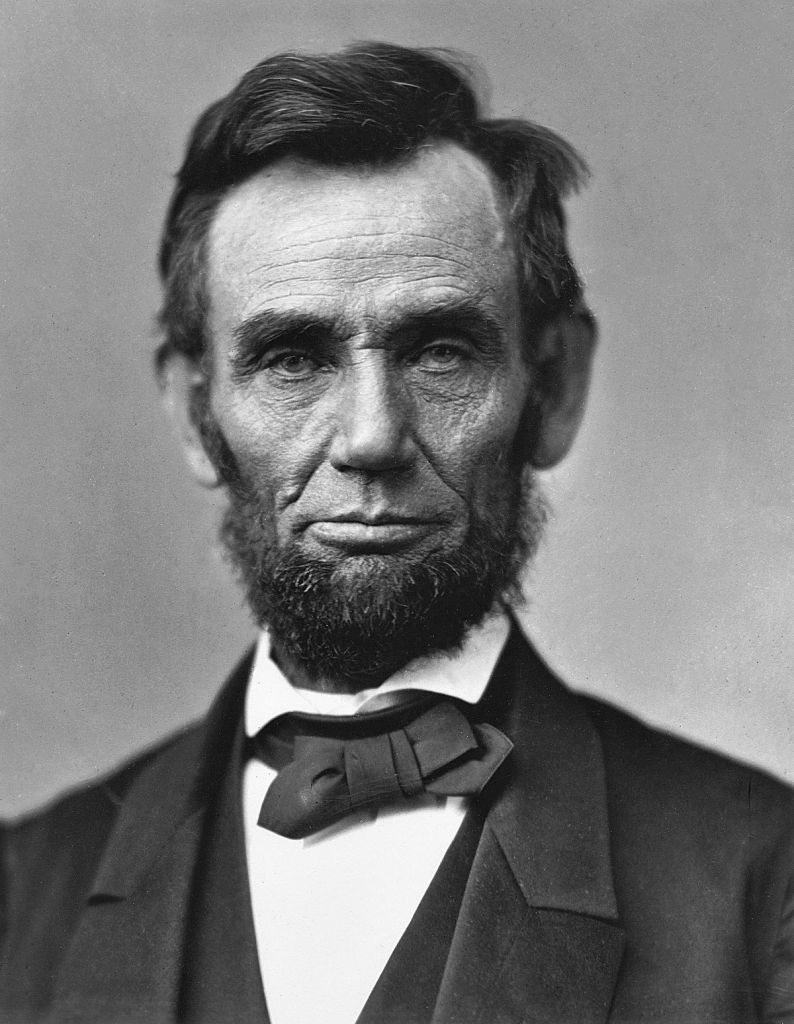
“I don’t like that person. I must get to know them better.” On a podcast today I heard Cass Sunstein attribute this quote to Abraham Lincoln. It stuck with me, and immediately I want to make it a permanent habit.

Hearing this got me thinking of people I’ve disliked in my past. In calling just two people to mind, I was surprised how powerful the negative emotions came on, even though I haven’t seen one in at least 10 years, the since high school, 20 years ago. Reflecting, I why good old Honest Abe’s advice resonates with me. When we don’t like someone, we tend to rehearse the things we don’t like about them, or our specific negative interactions with them, over and over again.

Before, during, and especially after our interactions with the person, we’re talking to ourselves about the things we don’t like. Sometimes for decades.

Abe’s antidote (which I now call it in my head) seems like a memorable, straightforward way to short-circuit that routine before it takes hold. That doesn’t mean it will be easy for everyone. But I’ve been lucky in my adult life that there are few people I dislike, and even fewer I need to interact with on an ongoing basis (actually right now, zero). For everyone I meet from now on, I hope in 20 years to feel about no one the way I feel about those few early antagonists. With this new heuristic, I actually think zero is an attainable goal. And if I ever bump into either of the two people I thought about today, I’ll try to get to know them better.

One of my favorite companies is trying to dump me, and I get it.

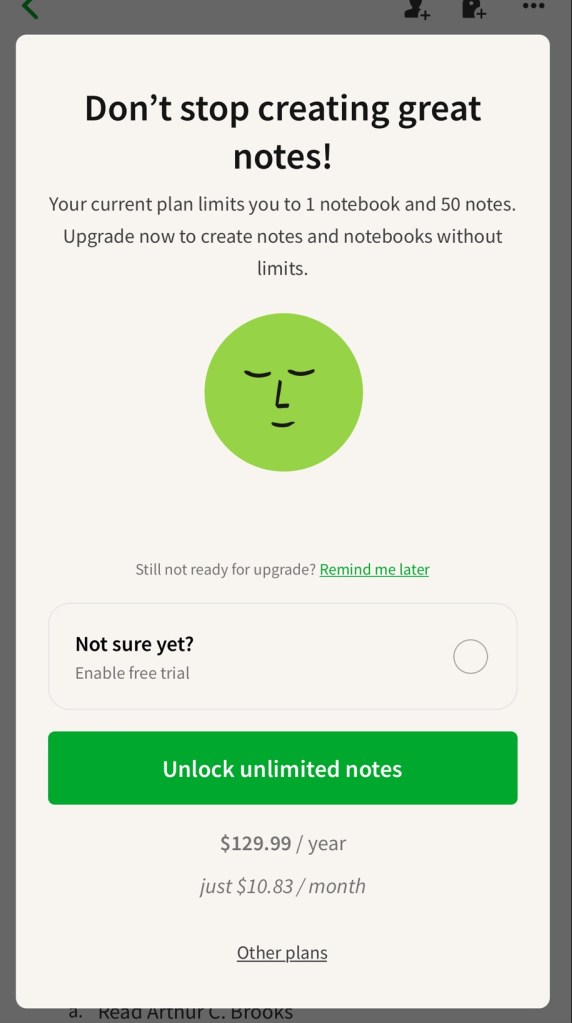
One of my favorite companies is trying to dump me, and I get it. I’ve been using Evernote for over 10 years, and suddenly they really, really want me to upgrade, or leave. Every time I open the app, I get a full-screen pop-up like this:

I have WAY more than one notebook and 50 notes.

Part of me does feel jilted … at ~20 years old, this company is one of the longest-running freemium consumer businesses on the internet. Now, the constant bombardment with upgrade pop-ups feels a bit like they’re punishing their free users for opting into that model.

But, I won’t listen to that part of me, because I understand what the company is dealing with. Evernote supports over 200 million users (!), with the vast majority on the free version. The company has weathered 2008, COVID, the latest tech bubble burst, and everything in between. Not to mention thousands of competitors with VC dollars to burn. In the meantime, the product has gotten better every single year, and I have consistently loved it.

Reading the announcement that preceded this upgrade campaign, I wasn’t surprised to learn that I use much more data and more functionality than the typical free user. This is why I’m part of the annoy-till-they-buy-or-quit cohort. And I have to give the Evernote team credit: six months into this, and it’s still just barely below the pain threshold that would have made me either upgrade or leave by now. They could have made it much less tolerable than a pop-up, or straight up forced me to upgrade or lose my data. Instead, I’ve been allowed to keep using the app, even though I’m way over the newly defined free tier. To their further credit, they understood they’d definitely lose some users doing this. They were honest about that in the blog, and they remain committed to users’ data ownership and data portability.

Like all software companies, Evernote is operating in a much tougher economic environment, and they could no longer support so many free users and so much free data. I’ve enjoyed almost 11 years of usage and improvements, at no cost. For all that time, Evernote worked hard to build the best app they could, and erred on the side of giving free users too much value, not too little. Now it’s time for me either to give back some of that value, or upgrade. I will probably upgrade … eventually.

“In all interactions, be either a teacher or a student.”

“In all interactions, be either a teacher or a student.” During my improv class last night, I was reminded of this mantra, which I adopted years ago during a period at work when I was really bored. Last night I was sitting there, a student, brand new, and still terrible at the thing we were practicing. It was uncomfortable, but not unpleasant. I was in the beginner’s mind. It was anything but boring.

Reflecting on that bad time at work, I remember endless meetings and busy work—nothing truly challenging, just overwhelming volume. Usually the answer to this type of challenge would be to prioritize what’s most important and ignore the rest. But I was also stuck in a rut, working on nothing very important. I didn’t want to leave, so needed to find something new to focus on. That search could fill only a small part of my day, so the rest was filled with picking up work no one else wanted to own.

So I was bored. Luckily, around that time a new leader joined us, who had an overt leadership style. He would spend as much time teaching others how to operate, think, decide, coach, as he would doing those things himself. He was always teaching.

And there I saw the answer to my boredom: like so many other problems, the best advice is the advice your grandma or grandpa may have given:

I fully endorse at least half of this sentiment.

Or to put it more encouragingly: Bored? Get curious.

If you feel like you’re on autopilot, ask how you could teach those around you to accomplish these things with as much mindless ease. If you feel others are wasting your time, find out why. Maybe they bored too, but no one has thought about whether this stuff is important.

Interestingly, practicing this mindset also helps you notice more viscerally when you’re the new, struggling, or confused person in the room. It makes you a better, more willing student. If every interaction is a teaching or learning moment, you can never be bored.

We saw Dune Part 2, and OMG.

We saw Dune Part 2, and OMG. I’ve never been in a theater so packed where the audience was so imperceptible. One of the things about going to the movies is you hear the people around you … crinkling wrappers, chewing popcorn, whispering to their date, whatever. Not Dune 2. For two hours and forty-six minutes straight, it felt like the entire audience was holding its breath as one, and digging its fingernails into the Music Box’s 90-year old armrests, not a muscle twitching in any of a couple hundred bodies. Go see in theaters, on the biggest screen you can. Look for a theater showing it in IMAX or 70MM. It’s worth it. To anyone in Chicago, I always recommend the Music Box.

Even more than the picture quality, the reason to see it in a special format like IMAX or 70MM is the sound. Just like the first installment, the sound design and sound effects for this movie are like nothing else you’ve ever seen heard. Part One won the Oscar for sound, and I’d be shocked if Part Two doesn’t win that, and probably more*. I joked coming out of the movie that they should just retire the sound category from the Oscars altogether, because this feels like the pinnacle sound effects in the movies. One of the big rewards for those who read the book (humblebrag) is hearing their bone-rattling depiction of “the voice,” a mind-control technique used by the Bene Gesserit.

A few days after seeing it, the other thing that has stuck with me is how scary this movie is. Not with jump scares or atmospheric creepiness like a horror movie. But the genuinely terrifying villains, who are scary in their delight for violence, their naked power seeking, their disdain for freedom and the law. It’s the worldview on display that is scary, more than the individual villains and their mobs. Because the parallels to our world today are so easy to see, where territorial imperialism, ethnic violence, drawn out trench warfare, and threats of atomic escalation are all back with us.

Edit: I realized I hit publish without finishing this post. I still hope everyone will see it, don’t let my downer of a review stop you. The movie is fun and it’s always darkest before the dawn!

May Shai-Hulud clear the path before you (to the Music Box or the nearest IMAX theater).

*PS speaking of the Oscars, how much of a bummer was it for the filmmakers who made shorts this year … when they heard WES ANDERSON made not one short, but several! I’d have been so mad!

I miss empanadas.

I miss empanadas. They are so good in Argentina (even better than Chile, sorry Chileans). I don’t know what makes them better, but I have a feeling it has to do with lard? We actually met a Japanese guy down there who initially said he came to see South America, but later admitted he came because he loved Empanada Mama in NYC and wanted the real thing.

I’m going on a mission to find the best ones in Chicago. Anyone have suggestions?

Goat empanada at Zonda in Mendoza.

ChatGPT is a university in your pocket.

ChatGPT is a university in your pocket. One new way use I’ve found for ChatGPT is to “go back to school.” I can design and take a course on-demand, but unlike a MOOC, I can also fully customize it. In pursuing my vision for this sabbatical, one of my ideas was to revisit some things I learned about way back, in some 100- or 200-level philosophy course: the aesthetic concepts of Awe and The Sublime.

Before getting into the details, how does this relate to my vision? Religion never resonated for me, but as I’ve gotten older, I’ve felt a pull to discover and develop the spiritual dimension in my life, in my own way. I’ve been meditating pretty consistently for several years, but during this time away from work I wanted to focus even more on the spiritual dimension of my life. Like all my interests, eventually I asked ChatGPT about it. This started as a conversation, and later I had the idea to ask ChatGPT to design an actual syllabus, for an imaginary course I wish I’d taken back in college.

Before ChatGPT, I would have done one of two things. Either I’d have ordered several books on my topic of interest, and probably not have read them; or I’d have done some haphazard Wikipedia and YouTube deep dives. The former is almost worthless. The latter is not much better—I would learn some surface-level stuff, but would be unlikely to engage with the material in an organized way. So I wouldn’t gain deep and lasting knowledge.

But ChatGPT has lowered the bar for engaging with complicated ideas. If you like the idea of taking a course, it can literally design the syllabus, organize the readings, generate lectures, and act as both a professor and TA. Most important for me, it makes me more likely to actually do the readings, because I can see where I am in the course and have a sense of progress; and because for any part that’s not interesting, I can just ask for a summary and skip it. At the margin, I’m much more likely to really learn something. If a full class isn’t interesting to you, you can structure your own learning however you want.

So before our honeymoon, I downloaded the first two readings from the syllabus to my Remarkable 2. Both are in the public domain, so I could easily find PDFs. I have been working through them at my own pace, and using ChatGPT for questions and context,

It’s obvious this technology will have an impact on Higher Education, or in my case, continuing education. But this is one way that it could be an opportunity for Higher Ed, rather than just a threat: let students design their more of their own courses, have professors review the syllabi and approve that they are “course credit worthy.” Assign TAs to give weekly oral quizzes, and then the professors design and administer oral mid-terms and finals. Maybe this can be done in cohorts, organized by year and major/elective area. I could see professors having fun with it too, adding personal favorites to the reading list, making it more esoteric but also ensuring it’s aligned enough with their knowledge base that they can easily administer the exams. We’ll see if universities embrace these types of experiments. I hope they do.
I’m finally taking an improv class.

I’m finally taking an improv class. Am I nervous? Yes, and excited. Improv comedy may be Chicago’s most important export, and is such a big part of cultural life in the city. Everybody knows somebody who is or has been deep in the improv game, moving up the levels at Second City, etc. Spending my 20s and 30s in Chicago, I always expected I’d eventually try it. Now I’m 35 and have time now, so it feels like now or never. Of course I’m not trying for SNL or anything. But I wanted to experience this part of Chicago’s culture before this phase of my life is over.

I did a little research on which class to take, but ultimately selected the program offered by my favorite place to see shows, the iO Theater. Last night was my first class, and I almost chickened out. But one of my rules for the sabbatical is to move toward the things that are scary. Mostly I was worried I’d be obviously the oldest person there, which wasn’t the case.

It was a blast. Uncomfortable in the right ways, and supportive in the right ways. Our teacher Sarah has a practiced but natural command of the room, obviously developed during her many hours onstage. She’s funny, obviously. Her advice to me after my first practice scene: “Make bigger choices.” I’m looking forward to the next eight weeks!

LLMs are still moving fast.

LLMs are still moving fast. I’d seen some speculation that a plateau is approaching, but so far it has not arrived. I’ve been out of the loop less than three weeks, and while I was gone: Google’s Gemini had a PR disaster, Anthropic launched its Claude 3 model family, and Groq launched its public web app (not to be confused with Grok).

The Groq launch made enough waves that despite being unplugged, I heard about it during our honeymoon and tried it out. The speed is impressive. Using Groq was a good reminder that on any dimension, one product’s “good enough” can be another’s differentiator. Six months ago, a one-, five-, or even ten-second wait for an answer from ChatGPT was absolutely worth it. The technology was so new and the conversations so valuable that the wait was both understandable, and obviously worth it. If you’d told me then that some new model (or in this case, some new architecture+hardware) was faster, I would not have been so excited. What I still want most is the better (more intelligent) model, not the faster one. I would have said speed is nice, but it’s clearly a secondary concern. That’s still how I feel, but my experience with Groq has made this a much closer call than I would have expected or predicted.

Groq’s primary product appears to be the chip and the architecture, not the chatbot, so I don’t expect to see my usage migrate from ChatGPT to Groq. Maybe OpenAI will acquire them. But it did get me reflecting on what would get me to change products, or adopt additional products for specific tasks. Over the past few months, 95% of my LLM usage has been via ChatGPT. I will try a new product when it launches—I tried out Gemini Pro 1.5 for a few days before we left on our trip, before its issues surfaced. I will also try different products when I want different opinions—for a recent research project I was asking the same questions simultaneously to ChatGPT, Gemini, and Claude. But so far, nothing has come close to displacing ChatGPT as my go-to LLM. The first-mover advantage is real, and OpenAI’s pace of innovation has been fast enough to retain their early lead, at least for me. But Groq reminded me that the race is far from won.

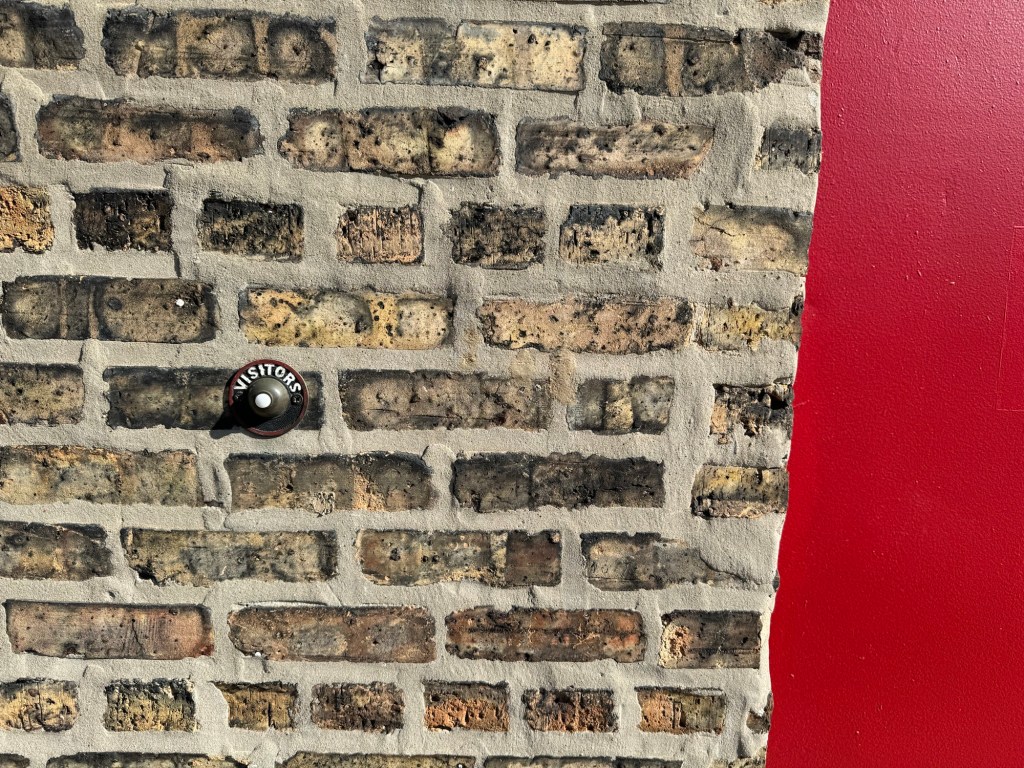
Has that doorbell always been there?

Has that doorbell always been there? Today I was walking from work to the coffee shop, a two-block stretch I’ve walked many times. But somehow I had never noticed this funny antique doorbell, though it’s at eye level and there’s not much else to notice on this block.

This little surprise got me looking around and noticing a bunch of other things in more detail. Big weird drainage pipes coming out of one building; attractive masonry arches on another; lots block glass windows. Purposefully noticing your surroundings can be like a walking meditation.

If you find yourself on auto-pilot while walking in your neighborhood, or even in your home or office, here a few things you can do to see your surroundings as new again:

  • Pick a color, and notice everything of that color. Choose red today, green tomorrow, blue the next day, etc.
  • Pick an object in your visual field, and try to focus not on the object itself, but on the space between you and it, almost as if you can see the air.
  • Pick a point in the distance. As you walk toward it, try and alternate between two perspectives: you moving toward the stationary point, vs. the point moving toward you. Does it work? Or is changing perspective in this way not possible?
  • Look for the thresholds and the seams … where a wall meets the ground, where a roof meets the sky, where the curb meets the street.

If you practice seeing something common with fresh eyes, that skill can bleed into other parts of your life in useful ways.