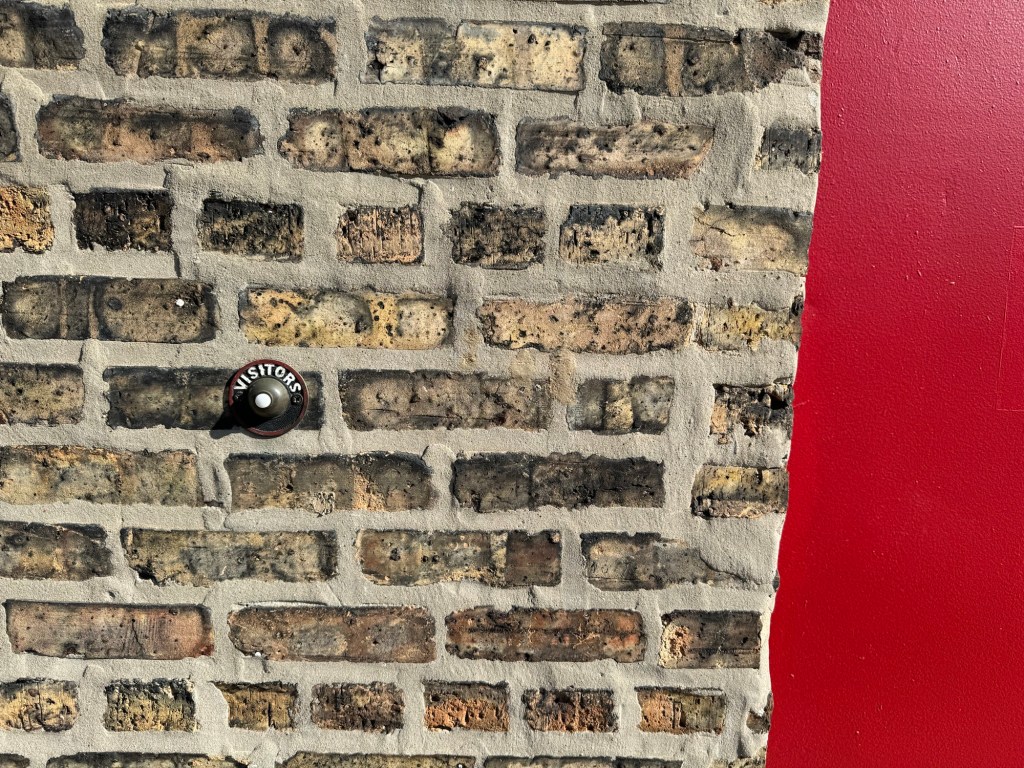
Has that doorbell always been there?

Has that doorbell always been there? Today I was walking from work to the coffee shop, a two-block stretch I’ve walked many times. But somehow I had never noticed this funny antique doorbell, though it’s at eye level and there’s not much else to notice on this block.

This little surprise got me looking around and noticing a bunch of other things in more detail. Big weird drainage pipes coming out of one building; attractive masonry arches on another; lots block glass windows. Purposefully noticing your surroundings can be like a walking meditation.

If you find yourself on auto-pilot while walking in your neighborhood, or even in your home or office, here a few things you can do to see your surroundings as new again:

  • Pick a color, and notice everything of that color. Choose red today, green tomorrow, blue the next day, etc.
  • Pick an object in your visual field, and try to focus not on the object itself, but on the space between you and it, almost as if you can see the air.
  • Pick a point in the distance. As you walk toward it, try and alternate between two perspectives: you moving toward the stationary point, vs. the point moving toward you. Does it work? Or is changing perspective in this way not possible?
  • Look for the thresholds and the seams … where a wall meets the ground, where a roof meets the sky, where the curb meets the street.

If you practice seeing something common with fresh eyes, that skill can bleed into other parts of your life in useful ways.

When was your last Aha! moment?

When was your last Aha! moment? The other day I referred to an “Aha! moment,” which depending on the context can also be called a Eureka Moment, a flash of insight, or even a brainstorm. Writing about it reminded me of a class I took in college called Insight in the Brain, where we studied the psychology of Aha/Eureka Moments, and the contrasts between “incremental” and “intuitive” problem solving.

Incremental problem-solving is long division, or checking every drawer until you find that sock. Insight problems are different. They usually can’t be solved little by little, by process of elimination, or with brute force. With insight problems, you’re sitting there with no answer and no progress, and then a solution comes to you, all at once, as if out of thin air. This can happen with hard problems that you’ve looked at from every angle but haven’t figured out; or with easy problems that require little effort. Either way, the answer comes suddenly, in a flash. If you know the problem space well, you may have an intuitive sense that there is a solution before you solve it; you just don’t see it yet.

In that class we learned the characteristics of insight problems, and the conditions under which insights usually occur. We also learned a clever way of studying them, a type of puzzled called a compound-remote-associates problem, where a subject is presented with three “problem words” and asked to find one “solution word.” For example, a problem triad could be crab / pine / sauce, and the solution could be apple (“crab apple,” “pineapple,” “applesauce”). Solutions to these problems tend to come all at once rather than incrementally or through trial and error, so they are good proxies for insight problems. And because they are easy to write and quick to solve, compound-remote-associates are convenient for testing various conditions under which insight can be boosted or blocked.

So how can we promote insight? First, do all the things you’d expect: get good sleep, hydrate, eat healthy foods, reduce stress, be in a good mood, etc. But for me the most important lesson from this class was simply to embrace subconscious processing. Give your subconscious some time and space to work.

Next time you have some problem you can’t quite crack, step away and think about something else. Or sleep on it for one or more nights. It really does work. Revisit the problem when and how you feel like it. Otherwise, relax and occupy yourself with other things. Eventually, the answer will hit you like a jolt from nowhere. It may happen on a walk, in a dream, or in the shower. Or even more poetically, in the bath, like the canonical (and still most famous) Eureka moment.

Ever since taking this class, I’ve been a huge proponent of allowing the subconscious to do its thing. Whatever the question, I am always encouraging people to “sleep on it.” And I mean literally. I sleep on things all the time. Most of the time I wake up with an answer. Even better, it feels like the solution has come “for free,” with none of the mental effort that would come with consciously working to an answer. There is no strain, it’s just there.

Try it out. Maybe you’ll engineer your own Aha! moment.
Our honeymoon will not be shot on iPhone.

Our honeymoon will not be shot on iPhone. At least not exclusively. My sister-in-law lent us her camera! She’s a photographer and is letting us use one of her old cameras on our trip. I say “old,” but it’s a professional-grade camera in great shape. We’re super grateful for her generosity, and excited to be amateur photographers during our travels.

She also gave us a brand new strap and a fresh SD card. We’ll pick up another SD card, so we’ll have 256 GB to fill, and I’ll be posting photos here during and after our trip.

We asked what we owed her for everything, and she laughed and said, “You owe me one camera, one strap, and one SD card. Just take care of everything and have fun.” We will.

We leave in two days. Thanks again Kerri!

“This moment is all you have.”

“This moment is all you have.” That’s an invocation often echoed during guided sessions on Sam Harris’s Waking Up app. It reminds meditators that the current moment—what you’re actually experiencing right now—is the only part of your life that stands a chance of being “real.” All else is either a memory of the past or a hope for the future, and is in your imagination. Most experiences pass, only partially noticed, as you become self-identified with the next thought, and the next.

Observing your own consciousness in the present instant is like “waking from a dream.” Every moment not spent in mindfulness (the vast majority of our lives) is like dreaming, or as he sometimes puts it: “most of your life is spent talking to yourself, about yourself.”

Some friends asked me to officiate their wedding.

Some friends asked me to officiate their wedding. I’m so honored! As most readers here will know, I love public speaking and one of my sabbatical goals is to practice as much as possible this year.

This wedding will be an opportunity to practice both writing and speaking, and in both efforts to summon as much heart and what little wisdom I can. I hope to be worthy of the occasion and to honor my friends.

Answering machines and obituaries are still funny.

Answering machines and obituaries are still funny. At least for now. I’ve been re-watching Curb Your Enthusiasm, Season 1, which originally aired in the year 2000. The episode premises are all about these things–answering machine messages; obituary typos in the physical newspaper; the cutoff time when calling someone’s home phone in the evening (and how it differs if they have kids?); which day of the week do you call to confirm Friday plans; hard-to-follow driving directions; etc.

More than half of Season 1 episodes seem to have at least one plot point hinging on home phones, “car phones,” answering machines, or pagers. The jokes still work for me, but I wonder if my kids will be able to relate to it at all. All the more reason to re-watch now!

I cannot wait until there are no more human drivers.

I cannot wait until there are no more human drivers. This thought initially crossed my mind when I first drove a Tesla. Lately, I think about it nearly every day, whether I’m walking, biking, or driving. During just a two mile trip this morning, I saw two blown red lights; two people swerve over the center line while texting; and two attempts to pass on the right in a bike or parking lane. That is a serious safety incident every 1/3 mile! The better self-driving technology becomes, the less safe I feel sharing the road with people.

I remember learning to drive as a kid, seeing oncoming traffic in the other lane, and being amazed at the level of trust we all put in each other with these machines. And that was before the constant distraction of smartphones. The societal value of cars has always outweighed the costs, I think by far. But within a few years we will be able to remove the safety trade-off from the equation altogether. If we have the political will.

As technology improves, the safety disparity between human drivers and machine drivers will become so glaring, so overwhelming, that fully autonomous cars will be legalized everywhere. I’m confident in this prediction. To make human drivers on open roads illegal will be harder, but I think worth trying. Car and gun fatalities in the US both come in around 40,000 per year. But the vast majority of car fatalities are accidental, while the vast majority of gun fatalities are not. So car fatalities should be more preventable. And unlike gun ownership, there is no explicit constitutional right to driving. So driving prohibition should be less legally controversial.

If it happens at all, the banning of human drivers in the US will proceed state-by-state, and may break along political lines. If it happens, the effort will likely be led by grassroots advocates, mostly families of victims–something like MADD on steroids. Car nuts can migrate to closed recreational courses, and the rest of us can text and ride, guilt free. I hope it does happen. I hope our societal attachment to the open road is less dear than our attachment to gun ownership.

I hope one day we all feel truly safe on the road, which to me would mean living in a time and place where humans aren’t allowed to drive. Until then, I’ll be cheering on Tesla and their competition as they race toward full autonomy.

Retrace your steps.

Retrace your steps. When you’re missing something, or feeling lost, stuck, or blocked. The other day I misplaced my favorite hat, then found it by retracing my steps.

Today I wasn’t sure what to write about, so I pulled a card from Oblique Strategies, and the card said, “Retrace your steps.” Oblique Strategies is a deck of cards with short encouragements, non-sequiturs, and pseudo-aphorisms, meant to clear creative blocks and promote lateral thinking. When you’re stuck, you pull a card, and try to do exactly what it says. Or, do the opposite. Or, do nothing, and just see what happens. Some other cards, pulled at random:

  • Breathe more deeply
  • Emphasize differences
  • Work at a different speed
  • Infinitesimal gradations
  • Discover the recipes you are using and abandon them
  • Turn it upside down
  • Do something boring
  • Tape your mouth
  • Honor thy error as a hidden intention

I’ve been carrying my Oblique Strategies deck with me the past few days. This morning my dad and I were reminiscing about a trip we took together 18 years ago to see the Steelers in the Super Bowl. Reliving it as an adult, specific memories felt entirely new to me, not in content but in context. So for the rest of today, I’m going to try to retrace my steps both physically and metaphorically, to see what seems new, what seems familiar, and what surprises me.

PS–if you’re interested, you can buy a deck here, or use this free online version.

“I think you’d do well on the internet.”

“I think you’d do well on the internet.” This is what a friend told me last night, and then we all laughed. We were discussing my blogging goals, our absence from social media, personal posts invading LinkedIn, and the contrasts between “cheugy” and “twee.”

For now, I’m happy if a few close friends and family read this. But who knows, maybe I’ll find my voice and find a niche in the blogosphere. So what do you think, can I make it on the internet?