I haven’t been listening to music anymore. I used to love discovering new music, and sharing old favorites. I once saw a poster for an artist at a cool bar in Berlin, and proudly became their superfan, seeing my own non-algorithmic discovery perform ~10 times in concert in the next half-decade.
But podcasts have taken over all the minutes and hours from music. It happened at first slowly, and then all at once, as the saying goes. And for me, this is a fine trade. I love my podcasts. I love the hosts. The inside jokes. The reliability of schedule. The balance: some of them highbrow for learning, some lowbrow for blowing off steam. And my rotation! My rotation is perfectly tuned to fill up my workouts, showers, and commutes each week, with each show for the right moment, all summing to just the right total runtime.
So I do miss listening to music. And I keep saying I’ll get back to it. But, I’ve realized doing so will require another trade, music to substitute for something else. My podcasts aren’t going anywhere. The most likely option is replacing an hour of evening streaming services while cooking dinner. That’ll happen once I get my record player fixed, I tell myself. But it’s been like a year and we do have the Sonos … maybe for this consumer, podcasts have just won.
Maggie Rogers is doing something cool again. As a reminder, her career launched with one of the coolest internet moments ever. As an undergrad at NYU, she got to attend a masterclass with Pharrell, and promptly blew his mind. Watch his visible, emotional reaction as he hears her song “Alaska” for the first time:
Several years and albums later, Maggie is about to kick off an arena tour. Like many artists, her reach (and ticket price) has outrun her fans’ perception of her. I think to many of her fans’, she’s still the quiet, indie, bedroom Taylor Swift.
Artists have struggled with ticket pricing in the streaming era. Touring and merch is now how anyone not named Taylor Swift makes money. But pricing tickets to maximize revenue can make your fans turn on you. Artists want to keep tickets affordable, but then resellers scoop all the tickets and capture the difference between the list price and the market clearing price. So for a few years there, some artists martyred themselves to their own image, by keeping GA tickets at $50 or whatever. They blamed the scalpers for the fact that no one at the shows actually paid that price.
The ticketing platforms slowly caught up, and have added price differentiation, or even launched their secondary markets where the artist is allowed to keep some of the resale value. But still, the only way to ensure your die-hards got affordable tickets was to do pre-sales via your email list, which can still be gamed.
So Maggie is doing something cool. She announced last-minute shows in major cities (Chicago is tomorrow at House of Blues, a mid-sized venue). Tickets will go on sale same-day, IN PERSON (9 AM for Chicago). Anyone who lines up at the box office but doesn’t snag a ticket for the intimate show tomorrow, can still buy a ticket for the United Center show in October, and I think some special merch.
I don’t know if Maggie is the first to do this, but I love it. It perfectly matches her image as a modern songwriting powerhouse with throwback indie roots. And it perfectly matches her desired relationship with her fans, while acknowledging her level of real-world of fame and success.
In Part 1 of this post, I listed some common stereotypes about the past several generations, specifically about their parenting styles and the effects those styles are supposed to have had on their kids.
Again, I’m interested in the perceived stereotypes about these generational parenting styles, and how they’re understood in popular culture. Not whether they are true, or how true they are.
So, looking back in 10 or 20 years, what will people say about Millennials as parents? How will we have succeeded, how will we have erred, and will popular opinion trace those errors back to some over-correction against our parents? What about the next two generations after us?
Another question: How much of Dr. Lipschitz’s advice seeped into the Millennial sub-conscious, and how will that impact our parenting style?
My predictions.
Millennials: Popular culture and think pieces will inform Millennials (my generation) that all the independence and adversity have been sanitized out of childhood. This trend had already begun when we were growing up, but when we look at Gen Z, we see that it has not yet crescendoed. We will be somewhat unique in that we react more to the generation behind us than to our parents. We will worry about a lack of grit in our kids, set out to reintroduce independence and adversity to our their lives.
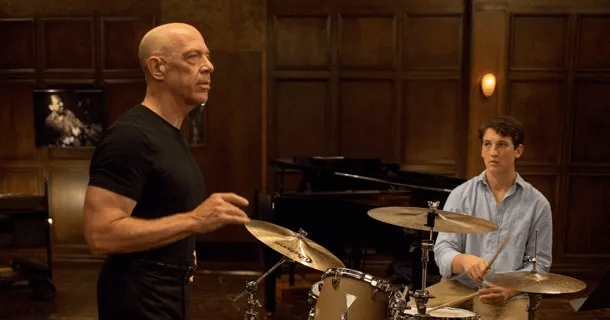
The pendulum is already moving back this way. But, Millennials will tend to take it too far. We will do weird stuff, like try to send our kids to sleep away Navy Seal Camp, or sign them up for music lessons with this guy:
“Not quite my tempo.”
Trying to manufacture opportunities for struggle and perseverance will have unintended consequences. Sometimes the experiences themselves will backfire in unexpected ways. Other times, our kids will see through our game and just not play. They will be more savvy than we expect, because they will be cynical-internet-natives; unlike us, they will have their guard up against social media that attempts to steal their attention and self-esteem. They will figure out a healthy balance between online and real life.
Gen Z: Will prioritize self-actualization and spiritual health in their kids, who will grow up to over-correct toward fostering ambition and material success.
Gen Alpha: Will scoff at their Millennial parents’ and Boomer grandparents’ machinations toward concocting a “healthy” childhood. Without knowing it, they will adopt their great grandparents’ attitudes. They will tell their kids to get out of the house after breakfast and be home before dark. They will assume what doesn’t kill the kids makes them stronger, but won’t conspire to put that assumption to the test. They will let kids be kids.
… Except, of course, all this will be supervised, encouraged, and kept safe for the kids by their AI playmates and tutors!
Put your own predictions in the comments. To summarize:
Lately I’ve been thinking about generational stereotypes, specifically the stereotypical parenting style of each generation. How do the circumstances, beliefs, and anxieties of one generation translate to quirks in its parenting style? And how do their kids react to and correct for those quirks when they become parents? That’s what this post is about.
Big Disclaimer: I’m interested in the perceivedstereotypes, and how they’re understood in popular culture. Not whether they are true, or how true they are.
In other words, I think it’s interesting to look at how popular culture imagines the differentiating features of each generation, regardless of how much predictive power those tropes have at the individual level. And even more interesting than observing how past generations is trying to guess what the next generation’s stereotypes will be. In Part 1 I will focus on the former, and then in Part 2 I’ll put down my predictions on the latter.
Stereotypes on parental styles of the past 100+ years, with a little help from ChatGPT:
The Greatest Generation (born approx. 1901-1927): Disciplined and distanced. Popular conception portrays a parental focus on authority and discipline, which builds resilience in kids, but possibly at the expense of parents’ emotional warmth and availability.
The Silent Generation (~1928-1945): Stable but stifling. I didn’t know this was a generation, thanks ChatGPT. The typical 50s & 60s stereotype continued; a preference for stability and conformity. Moving to the burbs, climbing the corporate ladder, expecting their kids to want the same.
Baby Boomers (~1946-1964): Trophies and Reality TV. The parents who told their kids, “You can be anything!” And both they and the kids believed it. I think this is largely a great thing. But the cost would be that some small number of kids really, really, believed it, and then found their grown up lives to be pretty normal, and therefore disappointing. Meanwhile, the previous generations are shaking their fists at Boomer parents and their Participation Trophy culture.
Gen X (~1965-1980):Helicopters and harm-prevention. This generation of parents has conflicting stereotypes, with the Latchkey Kids on one hand and the Micromanaged Achievers on the other. Based on emerging popular beliefs about Gen Z, the Helicopter Parenting style seems to have had the bigger influence.
Millennials (~1981-1994),Gen Z (~1995-2012), and Gen Alpha (~2013-2025): There are hypotheses, but we don’t really know yet!
In Part 2, I’ll try to predict how the next generations of parents will react, compensate, and over-correct when crafting their parenting styles. What will people say about Millennials and beyond, as parents?
A theme of my sabbatical has been learning—either gaining new skills or improving existing ones. I’ve been practicing writing, meditation, and golf. I’m taking my first improv class. I’m swimming again after a long break, and just got out of the pool for the first time this year. Finding my stroke and getting comfortable in the water took some effort. Though I’m not qualified, I gave my mom some tennis lessons, which made me focus on the instruction I’ve received in the few lessons I’ve taken. I tried horseback riding for the first time, and fly fishing for the second. I went skiing and focused on my form, and felt as capable as I ever have on skis.
Not since childhood have I been exposed to such steep learning curves across so many activities in such a short time. It’s fun, and it’s exactly what I wanted out of this period away from work.
I’ve also noticed the compounding effects of learning in parallel across disciplines. When you try to improve across a mix skills—some completely new and some well-established—your mind can tune into the learning process in a deeper way. You can bring the beginner’s mind even to things you’ve done since childhood (like swimming, for me). This means noticing more interesting details in each activity, while somehow simultaneously being less distracted by thoughts in the moment. It’s a great feeling, and one of many good reasons to always be learning new things.
Riding a bike always makes me feel like a kid again. It’s an easy shortcut to that magic feeling of flying, carefree, looking at the world like it’s brand new. Stacking so much learning into such a short period feels like riding a bike. I hope to never forget this feeling.
Living through the birth of both AI and true virtual reality, the US government acknowledging UFOsUAPs, a global pandemic and multiple history-shaking wars, all coinciding with economic prosperity for some, and famine and mass displacement for others. There’s a lot going on, and it can feel destabilizing.
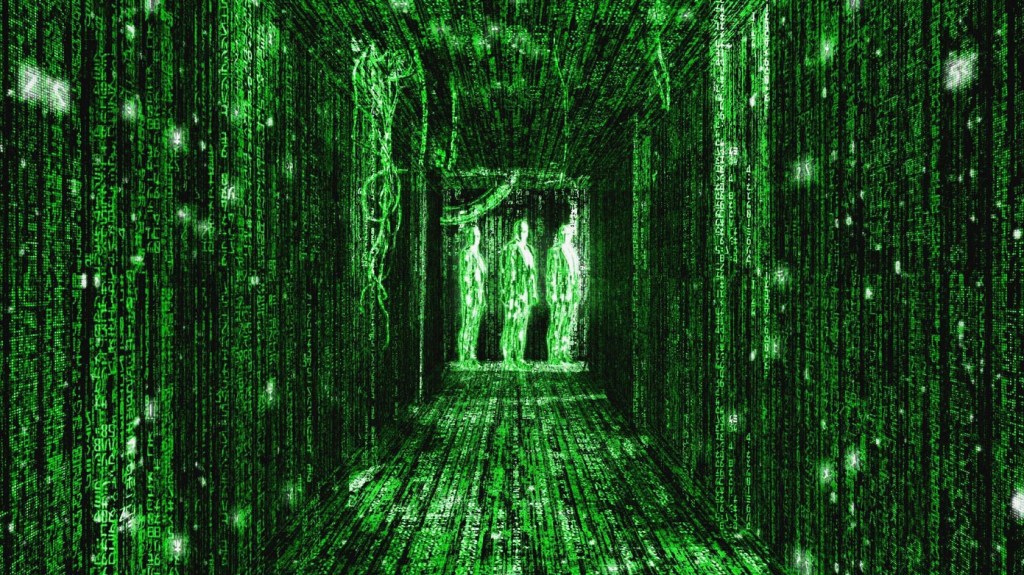
And for me, that destabilizing feeling has lately manifested itself in a strange way. Sometimes I just can’t escape the feeling that I’m looking through my eyes at some kind of projection. My mind keeps wandering back to a few years ago when a lot of tech people talked about the likelihood that our world is a simulation being run by a more advanced one. The chances of being alive during such a strange and momentous time feel so remote, that maybe our probabilistic brains are attracted to the simulation idea, because somehow it feels a more plausible idea among all this rapid change. I don’t remember ever having this feeling before a year or two ago. Now I feel it pretty often.
I don’t think we’re actually living in a simulation. Which makes this feeling even weirder when it hits me. The world just seems stranger, and change just seems to accelerate. It’s interesting to observe my mind as it integrates all this change, and the weird side effects, like fleeting suspicions toward reality itself.
My friend Jordan is always coming up with fun things to do, and always up for an adventure. He also knows me as well as anyone, we’ve been on the same life path since we graduated college and started at our first job together.
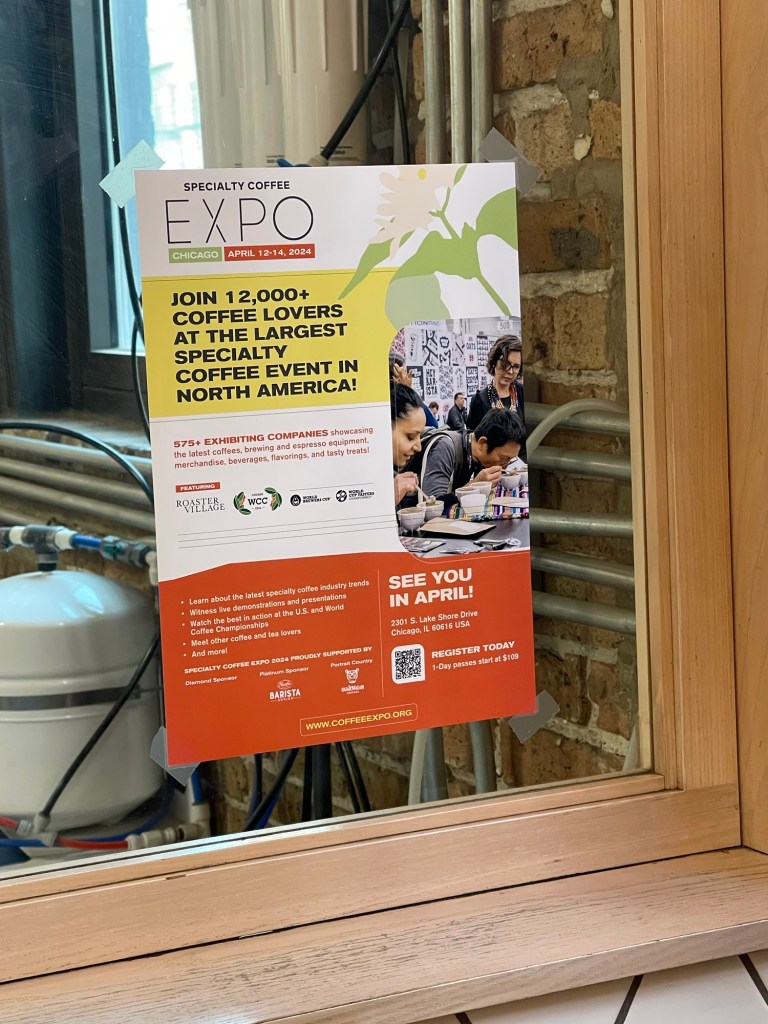
Jordan sent me this, which he saw at one of our favorite coffee shops, Metric’s roasters cafe.
Today he suggested we go to a coffee expo. It’s pretty clear from the site it’s intended for vendors, roasters, buyers, etc. But why not? Tickets are $25, so at worst it’s like seeing a bad movie, but at best it could be a mini-adventure. The real risk is we’re not 100% sure they actually will be serving coffee!
Either way it should be interesting. This idea is so Jordan, and it’s why I love him.
I just did a quick debrief call with the travel company that helped us plan and book our honeymoon, Jacada. They told me they were happily following this blog every day during the trip, which made me smile.
Melanie, Delfina, and everyone on the Jacada team were excellent at what they do. The local guides made the trip special; we got to meet and spend the days with some of the most lovely people in Argentina and Chile.
We had the trip of a lifetime, thank you again Jacada.
I’ve been trying to find the word to describe a particular phenomenon. The feeling is when you hear something for the first time, and it immediately and permanently changes your worldview. It’s similar to a flashbulb memory, but it’s knowledge rather than memory.
This is more like knowledge you’ve been primed to receive, with the background experience to solidify it, until you hear it distilled into an ultimate truth. For example, a mentor once told me, “I can’t teach or manage for ambition. By the time I meet an employee, nature and nurture have already conspired to give them some amount of ambition and hustle.” Hearing that felt like knowledge I’d never forget, that I’d always believe, both new and not–like I’d already sensed a version of it but couldn’t articulate it. But now, with the clarity my mentor provided, I’ll never lose that insight. It’s like pulling back the curtain on a ground truth, seeing it for the first time in its axiomatic clarity. What’s the word for that profound, transformative experience?
I asked ChatGPT, and it couldn’t come up with anything specific, but coined a phrase, “intimate resonance.” I like the phrase, but still felt like there must be an existing word that was closer to this feeling. I asked Claude, which first suggested “epiphany.” Which is close, but somehow smaller, and not personal enough. Epiphanies don’t always feel profound and direct. I asked Claude to try again.
“Ah, I see, there’s an even more specific term that captures that deeper, personal resonance you’re describing – “satori.”
Satori is a term from Zen Buddhism that refers to a profound, intuitive understanding or sudden spiritual awakening. It goes beyond just an epiphany or realization of a truth. With satori, there is a very personal, intimate connection and recognition of the truth that is being revealed. The key elements of satori that fit your description are:
It’s not just an intellectual understanding, but a deep, almost visceral recognition of the truth.
There is a sense of the truth “clicking” on a personal level, like it was always there waiting to be discovered.
The knowledge immediately feels integrated and embodied, not just an abstract concept.
It produces a profound shift in perception and worldview that feels permanent and transformative.
This feels exactly like the feeling I’ve been trying to describe, and searching to name. I’d like to learn more about satori in the context of Zen Buddhism.
PS–Score one for Claude 3 … on this particular task, their free model seems to outperform ChatGPT’s paid model. This makes me want to explore Claude 3 Opus, their Pro version.
I first fell in love with coffee and the cafe experience at The Wormhole, with it’s 80s nostalgia channeled through memorabilia small—Nintendo; Zelda figurines—and large—exact replica Janine Melnitz desk; actual Delorian mounted on the wall. Like many a hip spot on the Milwaukee corridor, it has aged out of its prime. The clever joke on the entryway, “Established 2015,” was an obvious Back to the Future reference … until 2015. The Wormhole will always hold a warm place in my heart, but it’s not quite as energetic as it was (then again, neither am I).
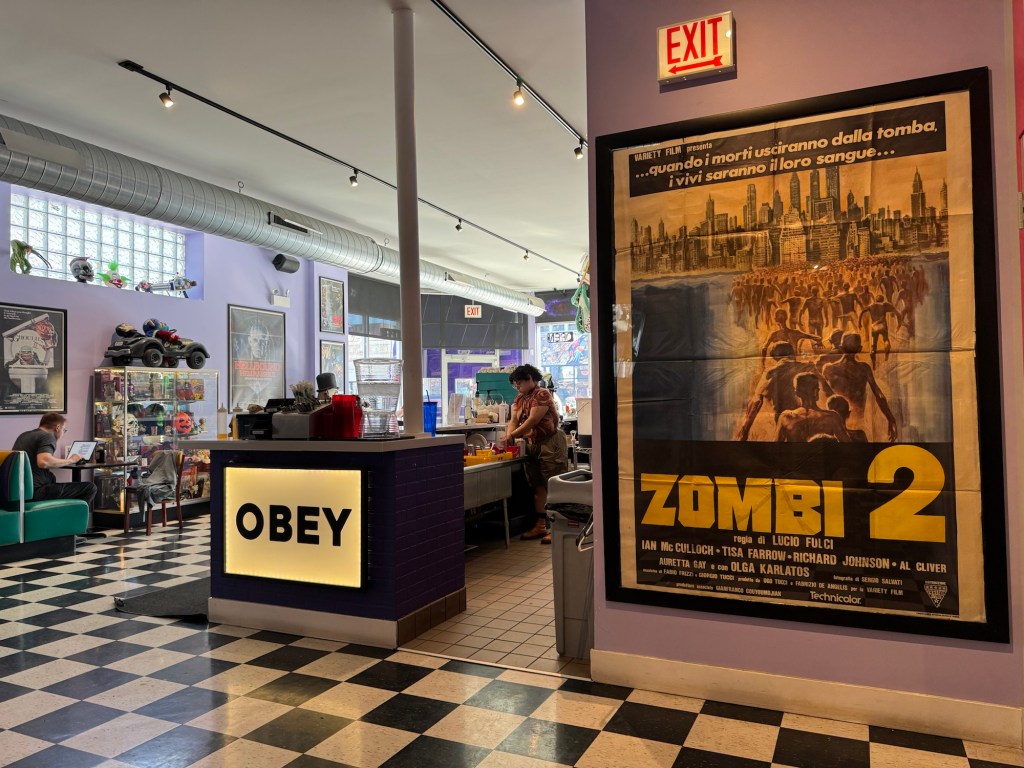
In Avondale, a few neighborhoods north on Milwaukee, I recently discovered The Wormhole’s spiritual sibling in The Brewed. Deriving its homophonic name from the David Cronenberg 80s movie, the space is overflowing with horror-genre memorabilia. I don’t think the two shops are actually related, though they do serve the same roaster’s beans.
Though I’ll never again spend months straight of Saturdays and Sundays alone at the Wormhole like I used to, it’s fun to see a new spot pick up where my favorite shop left off, and to see the younger clientele and baristas blasting music, joking around, and having fun at a space that feels like it’s there just for them.

 sabbatiblog